
I recently had the idea of making videos again. Previously, it was 'Lao Lü Talks Tea', which was the video content following the 'Tea on Paper' articles. My tea content output mainly consists of several series: 'Biographies of Tea People', 'Tea on Paper', and 'Lao Lü Talks Tea'. This time for videos, I want to start a new series called 'Lao Lü Healthy Tea'. If you're interested, you can follow in advance. The video content for 'Lao Lü Talks Tea' was a topic directory I manually organized. I'm not good at video organization; I always shoot in one take. This time for 'Lao Lü Healthy Tea', I have no choice but to do one take again, but for organizing topics, I used AI, which saved a lot of effort. I tried several, but I still think DeepSeek is the best. I've recorded my organizing process. If you're interested in video creation, you must take a look; it might save you a lot of time and help you discover more worthwhile video points. Of course, I won't share the topic directory for healthy tea; I'll record it under the broad theme of tea. Of course, AI can't replace you. Refer to AI, improve based on your own knowledge points, and form your own copy to be more effective. The following is the DeepSeek record.
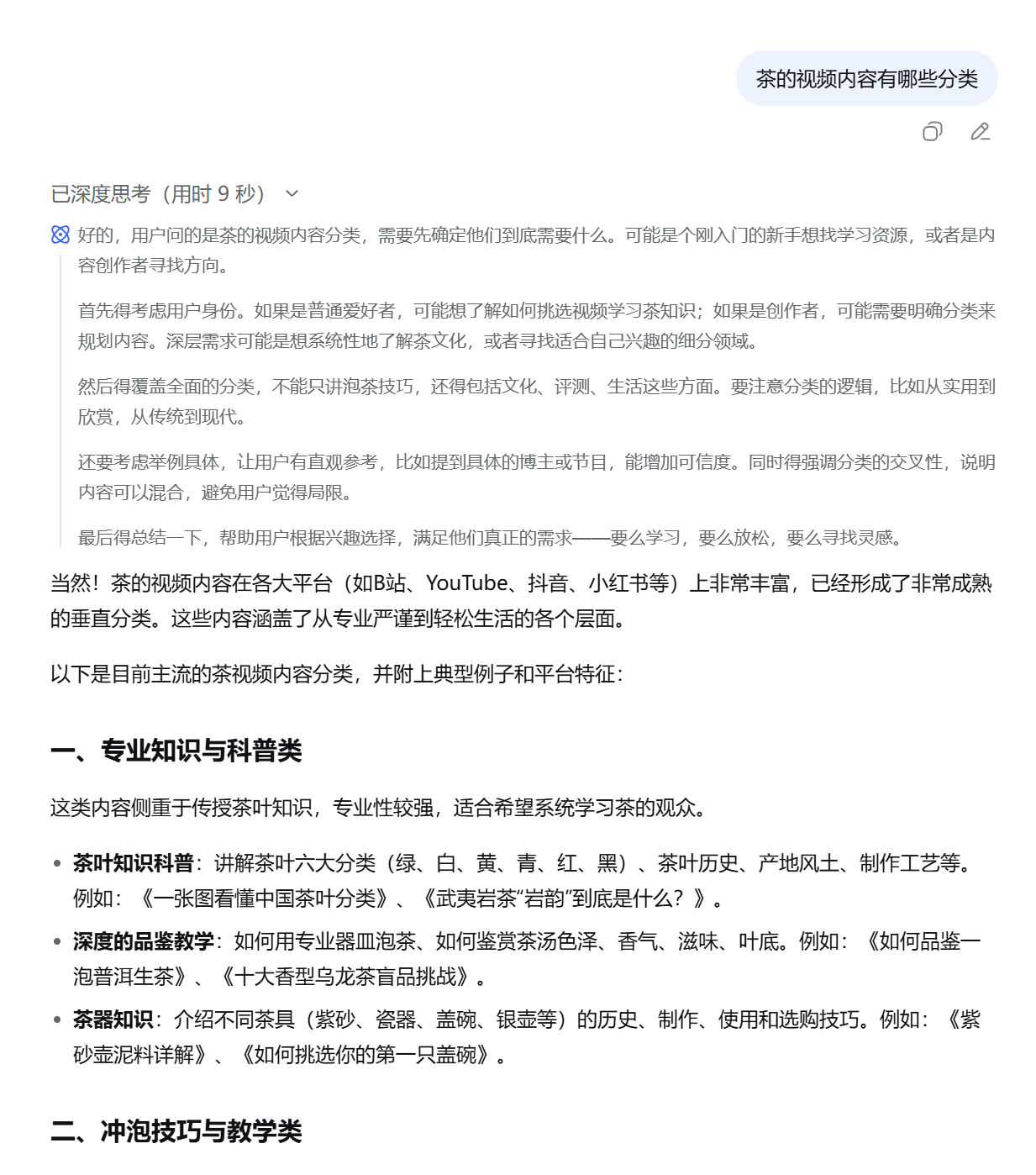
What are the categories of tea video content? (The green parts are my questions, as shown in the figure, and the following are similar.)
1. Professional Knowledge and Science Popularization
This type focuses on imparting tea knowledge, is highly professional, and is suitable for audiences who want to systematically learn about tea.
- Tea knowledge popularization: Explain the six major categories of tea (green, white, yellow, oolong, black, and dark), tea history, origin and terroir, production processes, etc. For example: "Understanding Chinese Tea Classification in One Picture", "What Exactly is the 'Rock Charm' of Wuyi Rock Tea?"
- In-depth tasting teaching: How to brew tea with professional utensils, how to appreciate the color, aroma, taste, and infused leaves of tea soup. For example: "How to Taste a Pu'er Raw Tea", "Blind Tasting Challenge of Ten Aromatic Oolong Teas".
- Tea ware knowledge: Introduce the history, production, use, and purchasing tips of different tea sets (purple clay, porcelain, gaiwan, silver pot, etc.). For example: "Detailed Explanation of Purple Clay Pot Clay Materials", "How to Choose Your First Gaiwan".
2. Brewing Techniques and Teaching
Focuses more on "how to do it", is highly practical, and is a category with large traffic.
- Standard brewing methods for different tea types: such as "Glass Cup Brewing Guide for Green Tea", "Seven Steps to Brew a Good Gongfu Black Tea", "How to Pry and Brew Pu'er Tea".
- Creative mixed drinks and cold brews: Combining tea with fruits, milk, alcohol, etc., to create fashionable drinks. For example: "Three Cold Brew Tea Tutorials You Must Learn in Summer", "Homemade Osmanthus Oolong Latte".
- "Beginner Mistakes" category: Correct common errors, such as "Five Reasons Why Your Tea Doesn't Taste Good", "Are You Really Using Your Purple Clay Pot Correctly?"
3. Reviews and Buying Guides
Similar to "digital product reviews", very popular among consumers, helping everyone "avoid pitfalls" and make purchasing decisions.
- Horizontal reviews of different brands/price points within the same category: For example, "Blind Test of 8 Popular Jin Jun Mei: Who is the King of Value for Money?", "What's the Difference Between 500 Yuan and 5000 Yuan Pu'er?"
- "Unboxing and tasting": Share newly purchased tea, describe real feelings and purchase channels. This is also very common in live streaming sales.
- Buying pitfall avoidance guides: Such as "Three Pitfalls to Avoid When Buying West Lake Longjing", "How to Identify Aged White Tea That Has Been Artificially Aged".
4. Tea Lifestyle and Aesthetics
This type does not emphasize professional knowledge output, but creates an atmosphere and lifestyle, focusing on aesthetic experience.
- Immersive tea drinking: No narration or only a few subtitles, showing the process of boiling water, pouring water, and decanting soup through ASMR (Autonomous Sensory Meridian Response), which is very relaxing.
- Tea space display: Show your own tea room, tea table arrangement, flower arrangement, antiques, etc., creating a leisurely artistic conception of Eastern aesthetics.
- "Tea Drinking Vlog": Record a day of tea-themed life, such as going to a tea house, attending a tea gathering, drinking tea in the mountains, etc.
5. Origin Exploration and Behind-the-Scenes
Satisfies the audience's curiosity about the source of tea, with documentary and travel elements.
- Tea mountain trips: Go deep into Yunnan Pu'er tea mountains, Wuyi Mountain rock tea areas, Fuding white tea areas, etc., interview tea farmers, and record the entire process from picking to making tea.
- Visiting time-honored brands/intangible cultural heritage inheritors: Visit well-known tea companies or non-genetic inheritors of tea making masters, showing the inheritance of traditional skills.
- Factory secrets: Visit modern tea processing factories to show the mechanized and standardized production process.
6. Culture, History, and Narrative
Content is more in-depth, usually appearing in documentary or long-form narrative forms.
- Tea culture documentaries: Such as "Tea: The Story of a Leaf", systematically telling the spread and historical influence of tea worldwide.
- Tea ceremony/tea art display: Show tea art processes from different regions of China, or Japanese tea ceremony, Korean tea ceremony, etc., focusing on ritual and cultural connotation.
- Historical story narration: Use animation or oral narration to tell historical allusions and anecdotes related to tea.
7. Entertainment and Cross-border Combination
Content is light and interesting, aiming to attract a broader young audience.
- "Tea drinking challenges": For example, challenge to drink 100 types of tea, drink the strongest tea, etc.
- Food crossovers: Combine tea with desserts and catering, such as "Making Tea Eggs with Lapsang Souchong", "Matcha Thousand-Layer Cake Making".
- Fun science popularization: Explain tea knowledge with animation or funny skits, such as "If Ancient Celebrities Also Drank Tea".
Summary
| Classification Dimension | Main Content Features | Typical Representatives | Main Platforms |
|---|---|---|---|
| Knowledge popularization | Rigorous, systematic, professional | Book-style explanations, expert appearances | Bilibili, YouTube |
| Brewing teaching | Practical, step-by-step, beginner-oriented | Tutorials, skill sharing | Douyin, Xiaohongshu, Bilibili |
| Reviews and buying | Consumer-oriented, comparative, real | Unboxing, blind tests, pitfall avoidance | Bilibili, Douyin, Xiaohongshu |
| Lifestyle aesthetics | Atmosphere, healing, visual | Immersive tea drinking, tea table Vlogs | Xiaohongshu, Douyin, Instagram |
| Origin exploration | Documentary, traceability, travel | Tea mountain trips, factory visits | Bilibili, YouTube |
| Culture and history | In-depth, narrative, documentary-style | Cultural documentaries, tea ceremony displays | Bilibili, YouTube |
| Entertainment cross-border | Light, fun, creative | Challenges, cross-border food | Douyin, Bilibili |
Many excellent video creators often combine multiple categories, such as incorporating professional knowledge into origin exploration or sharing brewing techniques in lifestyle Vlogs.
You can choose the type of video to watch based on your interests (whether you want to learn, buy something, or just relax).
According to these seven categories, please help me organize video content topics. Each major category requires more than ten topics, and dozens would be better (I continue to ask).
1. Professional Knowledge and Science Popularization
Suitable platforms: Bilibili, YouTube, Zhihu
- "The Ultimate Science Guide to China's Six Major Tea Families (Six Tea Types)"
- "Fermentation Degree vs. Tea Polyphenols: Understanding the Underlying Logic of Tea Classification in One Picture"
- "What Exactly is 'Rock Charm'? Uncovering the Terroir Code of Wuyi Rock Tea"
- "The Scientific Basis and Misconceptions of Pu'er Tea's 'Getting Better with Age'"
- "Flavor Map of Ten Major Pu'er Tea Mountains: Differences Between Laobanzhang, Bingdao, and Yiwu"
- "White Tea Grades: How to Distinguish Silver Needle, White Peony, Shou Mei, and Gong Mei?"
- "Exploring the Dark Tea Family: Yunnan Pu'er, Guangxi Liubao, Hunan Anhua Fu Brick"
- "Four Major Oolong Tea Producing Areas: Comparison of Northern Fujian, Southern Fujian, Guangdong, and Taiwan Styles"
- "Detailed Explanation of Tea Tasting Terminology: What are 'Water Path', 'Throat Charm', and 'Locked Throat'?"
- "Tea Internal Substances: How Do Tea Polyphenols, Caffeine, and Theanine Affect Taste?"
- "Evolution of Chinese Tea Laws Through the Dynasties: From Tang Dynasty Boiling Tea to Ming Dynasty Infusion"
- "Is 'Washing Tea' Really Necessary? Scientific Analysis of the Role of 'Warming and Moistening'"
- "The 'Shelf Life' and 'Optimal Drinking Period' of Tea"
- "Flavor Differences and Causes of Spring Tea, Summer Tea, and Autumn Tea"
- "'Core Producing Area' vs. 'Non-core Producing Area': Where Does the Price Difference Lie?"
- "Are the 'Golden Ring' and 'Cold Cream' of Tea Good or Bad?"
- "In-depth Analysis of the Scenting Process of Jasmine Tea"
- "The Difference Between 'Gongfu Black Tea' and 'Kung Fu Tea'"
- "Tea Seed Oil, Tea Polyphenol Extracts: Cross-border Applications of Tea"
- "The World's Three High-Aroma Black Teas: Keemun, Darjeeling, and Ceylon Uva"
2. Brewing Techniques and Teaching
Suitable platforms: Douyin, Bilibili, Xiaohongshu
- "Beginner's Guide: The Ultimate Guide to Using a Gaiwan Without Burning Your Hands"
- "Three Infusion Methods for Green Tea in a Glass Cup: Top, Middle, and Bottom"
- "How to Brew a Good Gongfu Black Tea? Master the Secret of 'Quick Pouring'"
- "Complete Process and Techniques for Brewing Ripe Pu'er Tea in a Purple Clay Pot"
- "Complete Cold Brew Tea Manual: Tea Selection, Ratio, Time"
- "Office Convenient Tea Brewing Solutions: Review of Steeping Cups, Travel Cups, and Water-Tea Separation Cups"
- "'Steeping' vs. 'Quick Pouring': Experiment on the Impact of Different Brewing Methods on Tea Soup"
- "How to Adjust Brewing Parameters (Water Temperature, Time, Tea Amount) to Save a Tea?"
- "Recreate Milk Tea Shop at Home: Tutorial for Making the Popular Yashi Xiang Lemon Tea"
- "Boiling Tea Around the Stove/with Electric Ceramic Stove: Suitable Tea Types and Precautions"
- "Creative Mixed Drinks: Making Yuanyang Milk Tea with Lapsang Souchong"
- "The Correct Way to Whisk Matcha"
- "Immersive Demonstration of Chaoshan Kung Fu Tea's 21 Techniques"
- "How to Brew Multiple Types of Tea with One Purple Clay Pot?"
- "Travel Tea Set Usage Experience and Recommendations"
- "Comparative Review of Brewing with Different Water Qualities (Mineral Water, Purified Water, Tap Water)"
- "The Principles Behind 'Han Xin Dians Bing' and 'Guan Gong Xuncheng'"
- "How to Easily Pry Pu'er Tea Without Crushing It?"
- "The Correct Way to Brew Tea in a Thermos Cup"
- "Homemade Fruit Tea Recipes (Peach Oolong, Pineapple Black Tea)"
3. Reviews and Buying Guides
Suitable platforms: Bilibili, Douyin, Xiaohongshu
- "Pitfall Avoidance Guide: 5 Tips to Identify Artificially Aged White Tea"
- "Comparative Review of Real and Fake Jin Jun Mei: Tongmuguan vs. Waishan"
- "Horizontal Blind Test of 100 Yuan/1000 Yuan/10000 Yuan Raw Pu'er: Where's the Difference?"
- "Unboxing Review of Ten Major Brands of Longjing Tea (Shifeng, Luzhenghao, Yifutang, etc.)"
- "Review of Popular Bagged Teas: CHALI, Tea Li, Lipton, Twinings"
- "Comparative Tasting of White Tea of Different Years: 1 Year, 3 Years, 7 Years"
- "What Does 'Tuition Tea' Look Like? Revealing Common Characteristics of Inferior Tea"
- "Online vs. Offline: Analysis of Pros and Cons of Tea Buying Channels"
- "'Daily Drinking Tea' Recommendations: Cost-effective Teas Under 100 Yuan"
- "Beginner's Guide to Buying Purple Clay Pots: How to Judge Clay, Shape, and Craftsmanship?"
- "Review of Gaiwan Materials: Which is Better: White Porcelain, Celadon, Glass, or Wood-fired?"
- "Are 'Master Tea' and 'Intangible Cultural Heritage Inheritor Tea' Worth the High Price?"
- "Introduction to Pu'er Tea Brands: How to Choose Dayi, Xiaguan, Chengsheng Hao, and Rongshi?"
- "Exploring Niche Teas: Anhui Yongxi Huoqing, Jiangxi Ninghong, Hunan Anhua Tianjian"
- "Review of 'Internet Brands': Xiaoguan Tea, CHALI, Yinian Caomu Zhong"
- "Review of Different Grades of the Same Brand (e.g., Bama Sai Zhenzhu 1000/2000/3000)"
- "Unboxing '9.9 Free Shipping Laobanzhang': Let's See What It Is"
- "How to Read Information on Tea Packaging: Understand Production Date, Grade, and Origin"
- "Valuation Factors of Aged Pu'er Tea: Brand, Storage, Appearance"
- "'Tea Sample' Tasting Experience: How to Find a Tea Suitable for You at Low Cost?"
4. Tea Lifestyle and Aesthetics
Suitable platforms: Xiaohongshu, Douyin, Bilibili
- "Morning Ritual: My 15-Minute Healing Breakfast Tea Time"
- "ASMR Immersive Tea Drinking in the Rain, Healing All Anxiety"
- "Creating My Mini Tea Table/Window-side Tea Station"
- "Four Seasons Tea Table Arrangement Inspiration: Spring, Summer, Autumn, Winter Themes"
- "One Person, One Pot, One Cup: Weekend Solo Tea Drinking Vlog"
- "Tea Ware Collection Sharing: My Favorite Wood-fired Cups"
- "Tea and Incense: What Incense to Pair with Tea Tasting?"
- "Tea and Reading: This Week's Book List and the Tea Accompanying Me"
- "Traveling with Tea Set: What's It Like to Brew Tea in the Mountains and Rivers?"
- "Shop Visit Vlog: Exploring Healing Tea Houses in Urban Corners"
- "Chinese Aesthetic Outfit for a Spring Tea Gathering"
- "The Art of Tea Snacks: What Tea Snacks Should Be Paired with Different Teas?"
- "Tutorial for Creating a Cozy Atmosphere of Boiling Tea Around the Stove in Winter"
- "My Tea Room Green Plant Pairing: Asparagus Fern, Acorus, Orchids"
- "'Useless Beauty': An Ordinary Day of Flower Arrangement, Appreciating Ware, and Drinking Tea"
- "Traditional Culture Experience: Learning Song Dynasty Tea Whisking/Japanese Urasenke Tea Ceremony"
- "Mother's Day/Father's Day: Brew a Warm Cup of Tea for Family"
- "Tea and Music: Playlist of Chinese Style/Classical/White Noise Suitable for Tea Drinking"
- "Evening Tea: Non-Insomnia Tea Drinks Suitable for Night"
- "Slow Life Weekend: Full Record from Setting Up the Tea Table to Cleaning the Tea Set"
5. Origin Exploration and Behind-the-Scenes
Suitable platforms: Bilibili, YouTube
- "Yunnan Pu'er Tea Mountain Trip: Deep into Laobanzhang Village, Visiting the Tea King Tree"
- "Fuding Panxi Town: Following a Tea Farmer for a Day, Recording the Birth of Silver Needle White Tea"
- "Hiking Exploration of the Core Producing Area of Wuyi Rock Tea: 'Three Pits and Two Streams'"
- "Visiting Jingdezhen: How is a Handmade Blue and White Gaiwan Made?"
- "Entering Yixing Dingshu Town, Unveiling the Whole Process of Purple Clay Pot from Clay to Finished Product"
- "Visit to a Modern Tea Factory: See How Machinery Replaces Traditional Tea Making"
- "Exclusive Interview with Intangible Cultural Heritage Inheritor: Dialogue with Master of Wuyi Rock Tea (Da Hong Pao) Making Technique"
- "Anhua Dark Tea: Unveiling the Mystery of 'Golden Flowers' (Eurotium cristatum)"
- "Taiwan High Mountain Tea Gardens: Visit to Alishan, Lishan, and Dayuling"
- "Hangzhou Meijiawu: On-site Record of Longjing Tea Picking Season"
- "Visit to Hengxian, Guangxi, the Hometown of Jasmine Tea, to See the Night Scenting Process"
- "Exploring Border Tea: Yunnan Fengqing Dianhong Journey"
- "Behind the Scenes: Unveiling the Design Process of Tea Packaging"
- "Daily Work in a Tea Tasting Room: What's It Like to Drink Hundreds of Teas in a Day?"
- "Visit to a Matcha Plantation in Shizuoka, Japan"
- "Exploring Darjeeling Black Tea Estates in India"
- "Insights into the Tea Auction Market: How Are Sky-high Priced Teas Born?"
- "The Real Life and Income of Tea Farmers"
- "Organic Tea Garden vs. Ordinary Tea Garden: On-site Comparison"
- "What Fun and Interesting Things Are There at a Tea Expo?"
6. Culture, History, and Narrative
Suitable platforms: Bilibili, YouTube
- "Tea Horse Road Documentary: The Expedition of a Tea Leaf"
- "Close Reading of 'The Classic of Tea': What Lu Yu Tells Us"
- "Origins of Japanese Tea Ceremony: How Did Tang and Song Tea Culture Cross the Sea?"
- "British Afternoon Tea Culture: From Portuguese Princess to Victorian Era"
- "Tea Trade and Cultural Exchange on the Silk Road"
- "Emperor Huizong of Song and 'Daguan Tea Treatise': The Ultimate Aesthetics of Song Dynasty Tea Whisking"
- "How Did Tea Become the Trigger for the Opium War?"
- "Zen and Tea: The Thousand-Year Connection Between Buddhism and Tea Culture"
- "Appreciation of Tea Paintings Through the Ages: From 'Xiao Yi Swindling Lanting' to 'Tea Tasting Painting'"
- "Tea Culture in 'Dream of the Red Chamber': Tea Tasting at Longcui Nunnery (Liuan Tea, Laojun Mei)"
- "Unique Tea Drinking Customs Around the World: Mongolian Salty Milk Tea, Indian Masala Chai, etc."
- "The Tea Story Behind the 'Boston Tea Party'"
- "The Road to Revival of Modern Chinese Tea: Stories of Pioneers like Wu Juenong"
- "Science of Tea Variety Cultivation: Stories Behind Generations and Numbers"
- "Appreciation of Antique Tea Ware: Tang and Song Tea Sets and Ming and Qing Tea Ware"
- "Chronicle of Tea Advertisements: Look at Old Advertisements from the Last Century"
- "Tea Culture in Dialects: Chaoshan 'Eating Tea', Sichuan 'Gaiwan Tea'"
- "Tea Elements in Peking Opera/Pingtan"
- "Tea and Health: Records in Historical Classics and Modern Research"
- "The New Tea Road on the 'Belt and Road'"
7. Entertainment and Cross-border Combination
Suitable platforms: Douyin, Bilibili
- "Challenge to Drink All Types of Chinese Tea"
- "Precision Tea Brewing with Laboratory Equipment (Measuring Cylinder, Balance, Thermometer)"
- "Tea Blind Tasting Challenge: Can 'Old Tea Drinkers' Tell the Price?"
- "Brewing Tea with Various Strange Containers: Trophy, Fish Tank, Hat..."
- "When I Drink Tea with My Mom/Dad/Grandma: Generation Gap Collision"
- "Cost Breakdown of 'A Cup of Tea': Who Earns the Money from Tea Garden to Tea Cup?"
- "Cooking with Tea: Tea Eggs, Longjing Shrimp, Pu'er Braised Pork Tutorial"
- "DIY Tea Drinks: Recreate Chayan Yuese's Youlan Latte"
- "Tea-flavored Desserts: Making Matcha Chocolate, Earl Grey Chiffon Cake"
- "Tea Culture in Games/Anime: The Teapot in 'Genshin Impact', the Tea Room in 'Ghost of Tsushima'"
- "Sing the Six Major Tea Categories in Rap/Animation Form"
- "Giving Chinese Tea to Foreign Friends: What Are Their Reactions?"
- "Unboxing the 'Most Expensive' Tea Sample, Hands Shaking"
- "'Online Dating Meets Offline': Internet-famous Tea vs. Physical Store Tea"
- "How to Elegantly Drink Tea While Petting Cats/Walking Dogs?"
- "What's It Like to 'Drink Only Tea for a Day'?"
- "Using Memes/Jokes to Complain About Tea Drinking Moments"
- "Exchange Drinks with a Barista Friend: I Drink Pour-over, He Drinks Kung Fu Tea"
- "Creative Uses of Tea Leaves: Deodorizing, Fertilizing Flowers, Making Pillows"
- "Host a Family Mini 'Tea Competition'"
Now we can use DeepSeek to generate articles based on each topic, and we can also modify the titles.
"The Ultimate Science Guide to China's Six Major Tea Families (Six Tea Types)" is the article title. Please help me organize a detailed article covering the introduction of the viewpoint proposer, time, background, and which teas are included in the six major tea types, and what is worth recording about these teas including origin, taste, craftsmanship, culture, etc., and also include the shortcomings of the six major tea classification and future prospects.
The Ultimate Science Guide to China's Six Major Tea Families (Six Tea Types)
A leaf from the East has given rise to countless aromas and flavors, yet it also brings confusion and controversy in classification.
China is the only country in the world that produces all six major tea types: green, white, yellow, oolong, black, and dark tea. Each of these six families has its own merits and origins, forming the rich diversity of Chinese tea culture.
In 1979, Professor Chen Chuan from Anhui Agricultural University, one of the founders of tea science higher education, first proposed the scientific classification method of six major tea types in his article "Theory and Practice of Tea Classification".
This classification laid the foundation for modern scientific tea classification and has been widely recognized and applied. After more than forty years of development, this classification system has finally gained international recognition.
01 The Origin of the Six Major Families: Professor Chen Chuan and the Classification System
The history of Chinese tea classification can be traced back to ancient times, but it was mostly based on intuitive experience and perceptual knowledge. The Tang Dynasty "The Classic of Tea, Chapter Six" records "coarse tea, loose tea, powdered tea, and cake tea"; the Song Dynasty "History of Song, Food and Goods" records "tea has two types: cake tea and loose tea".
These classifications lacked systematization and did not theoretically clarify the classification principles. Professor Chen Chuan's classification method proposed in 1979 divided tea into six categories: green, yellow, dark, white, oolong, and black, based on the order of flavanol content in tea.
This classification not only retained the tea names summarized through historical experience but also conformed to the inherent laws of tea's internal changes and development. In April 2023, the international standard ISO 20715:2023 "Tea Classification" formulated under the leadership of Professor Wan Xiaochun from Anhui Agricultural University was officially promulgated, marking the international consensus of China's six major tea classification system.
02 Green Tea: The Fresh Choice of Non-fermented Tea
Green tea is the most produced tea in China, with origins across the country. Its process feature is that after picking, the fresh leaves are quickly heated to destroy the enzymes, inhibiting the oxidation of tea polyphenols (non-fermented).
Green tea has the "three greens" characteristics: "dry tea is green, tea soup is green, and infused leaves are green". Green tea is rich in chlorophyll and vitamin C, has a cooler nature, and higher caffeine content.
According to different fixing and drying methods, green tea can be divided into pan-fired, baked, sun-dried, and steamed. Representative famous teas include West Lake Longjing, Biluochun, Huangshan Maofeng, etc.
03 White Tea: The Natural Beauty of Light Fermentation
White tea is a lightly fermented tea (fermentation degree 5%-10%), mainly produced in the Fuding area of Fujian. The production process of white tea is the simplest and most natural, with only two steps: withering and drying.
White tea gets its name because the finished tea is covered with white down, like silver and snow. Its soup color is light, and the taste is fresh and refreshing. It is cool in nature and has the effect of reducing heat and lowering fire.
White tea is divided into bud tea and leaf tea based on raw materials. Bud tea is made entirely from the plump buds of Dabai tea, represented by "Silver Needle White Tea"; leaf tea uses one bud with two or three leaves or single leaves as raw materials, with varieties such as White Peony, Gong Mei, and Shou Mei.
04 Yellow Tea: The Rare Product of Light Fermentation
Yellow tea has a slightly higher fermentation degree than white tea, generally between 10% and 20%, belonging to lightly fermented tea. Yellow tea may be the least noticed and least present tea among the six major types.
During the production of yellow tea, there is a core process called "sealing yellow", which gives it the quality of yellow leaves and yellow soup, and a unique sweet and mellow taste. Yellow tea developed from mistakes or improper mastery of green tea production techniques.
According to the tenderness of fresh leaves, yellow tea can be divided into three categories: yellow bud tea, yellow small tea, and yellow big tea. Representative teas include Junshan Silver Needle, Mengding Yellow Bud, Huoshan Yellow Bud, etc.
05 Oolong Tea (Qing Tea): The Rich Charm of Semi-fermented Tea
Oolong tea, also known as Qing tea, has a changeable temperament, combining the freshness of green tea and the mellow of black tea. Its fermentation degree lies between green tea and black tea, ranging from 8% to 75%.
The process of oolong tea is complex and time-consuming, with "shaking green" being an important step, which forms its special aroma and the characteristic of green leaves with red edges. Oolong tea aromas range from fresh floral to ripe fruit scents.
Depending on the origin, oolong tea is divided into four categories: Northern Fujian oolong, Southern Fujian oolong, Guangdong oolong, and Taiwan oolong. Representative teas include Tieguanyin, Wuyi rock tea, Phoenix Dancong, etc.
06 Black Tea: The Mellow Taste of Fully Fermented Tea
Black tea belongs to fully fermented tea (fermentation degree greater than 80%), and its birthplace is now Tongmuguan (village) in Wuyi Mountain, Fujian. The difference between black tea and green tea lies in an additional fermentation process.
The basic process flow of black tea is withering, rolling, fermentation, and drying. Fermentation is the key step that forms the quality of black tea's red soup and red leaves.
Black tea dry tea is dark and oily, with a generally high and persistent aroma, a sweet floral and fruity fragrance, and a mellow taste without astringency. The soup color and infused leaves are both red. It is mild in nature, and because of lower caffeine, it has a lower stimulating effect on nerves.
Representative teas include Lapsang Souchong, Keemun black tea, Dianhong, etc.
07 Dark Tea: The Mellow Drink of Post-fermentation
Dark tea is post-fermented tea. The raw materials selected are relatively coarse and old, and due to the long stacking fermentation time during production, the leaves are mostly dark brown. The basic process flow of dark tea includes fixing, rolling, piling, and drying.
Unlike other tea types, the fermentation of dark tea does not use the enzymes of the tea itself, but enzymes produced by microorganisms, so it helps digestion and is gentle on the stomach. Dark tea dry tea is generally dark and moist, the soup is clear and bright yellow, the aroma is mellow, and the taste is thick and sweet.
Dark tea is mainly produced in Hunan, Yunnan, Guangxi, and other places. Representative teas include Anhua dark tea, Pu'er tea, Liubao tea, etc.
08 Classification Controversy: Shortcomings and Disputes of the Six Major Tea System
Although the six major tea classification system has become an international standard, with the continuous innovation of tea products and the increase in categories, this classification system has also shown certain limitations.
The classification of Pu'er tea is the most prominent issue. In June 2023, the Yunnan Provincial Pu'er Tea Association held a seminar on opinions and suggestions on tea classification, where experts had a heated discussion on "What kind of tea is Pu'er tea?"
Some experts clearly stated: "Pu'er tea does not belong to dark tea; Pu'er tea should be listed as a separate category."
The six major tea classification is mainly based on process and quality characteristics, but it fails to fully reflect the deep chemical composition and efficacy differences of tea. The characteristic components of each tea type are unclear, and efficacy research is broad and lacks distinctiveness.
The traditional classification system also restricts the development of new products and innovative categories to a certain extent. People habitually fit new products into the framework of the six major tea types, limiting the innovation space of tea products.
09 Future Prospects: Development Direction of Tea Classification
Future tea classification needs a more scientific theoretical foundation. In-depth research is needed on the formation mechanism of the quality of the six major tea types and the identification of characteristic components. This includes clarifying the key process mechanisms, characteristic components of each tea type, and the efficacy of each tea type.
The tea classification system also needs to remain open and inclusive. With the innovation and development of tea products, the traditional six major tea classification may need adjustment and expansion, and even consider adding new tea categories.
Integrated innovation is the only way for the development of the tea industry. It is necessary to integrate the theoretical and technical achievements of the six major tea types, break the shackles of the traditional "six major tea types", and use modern flavor design and processing technology to develop more and broader products.
10 Conclusion: The Ultimate Meaning of Tea Tasting
The six major families of Chinese tea each have their own characteristics and charm. Green tea is fresh and natural, white tea is simple and elegant, yellow tea is rare and low-key, oolong tea is rich and changeable, black tea is mellow and warm, and dark tea is mellow with aged fragrance.
Tasting tea is not only about tasting a beverage, but also experiencing a culture and a lifestyle. The foundation of Chinese tea culture can be summarized in three words: "observe, smell, and taste": "observe" means watching the shape of the tea leaves and the infused leaves; "smell" means smelling the aroma; "taste" means tasting the smoothness and thickness of the tea soup.
In April 2023, the international standard ISO 20715:2023 "Tea Classification" was officially promulgated.
This standard was formulated under the leadership of Professor Wan Xiaochun from Anhui Agricultural University, together with 31 tea experts from various countries, marking that China's six major tea classification system has become an internationally accepted standard.
The future development of tea needs innovation in inheritance and exploration in science, so that this magical leaf from the East can continue to nourish human health and culture.
Paragraph comments 0 · moderated
Comments 0 · moderated