
This is the thirty-second article in my "Tea Talk on Paper" series. Click to read more articles from "Tea Talk on Paper".
This article is full of experience, my personal feelings and perceptions, no data. "Scientific tea drinkers" please exit reading promptly!
A tea that makes the body comfortable should have a comfortable taste, smooth body sensation, and a lingering aftertaste.
Many times, when I drink tea, I don't pay much attention to the taste; I focus on the overall feeling of the tea. Often, when I taste tea with fellow enthusiasts and find it good, they ask about the taste, and only then do I carefully notice sweetness, astringency, aftertaste, and other specific flavors. This overall feeling is a kind of imagery. The first time I mentioned imagery was in an article I wrote in 2016, "Tea Talk on Paper No. 14: Ten Indicators of Ancient Tree Ripe Pu-erh". Today, I will expand on it here.
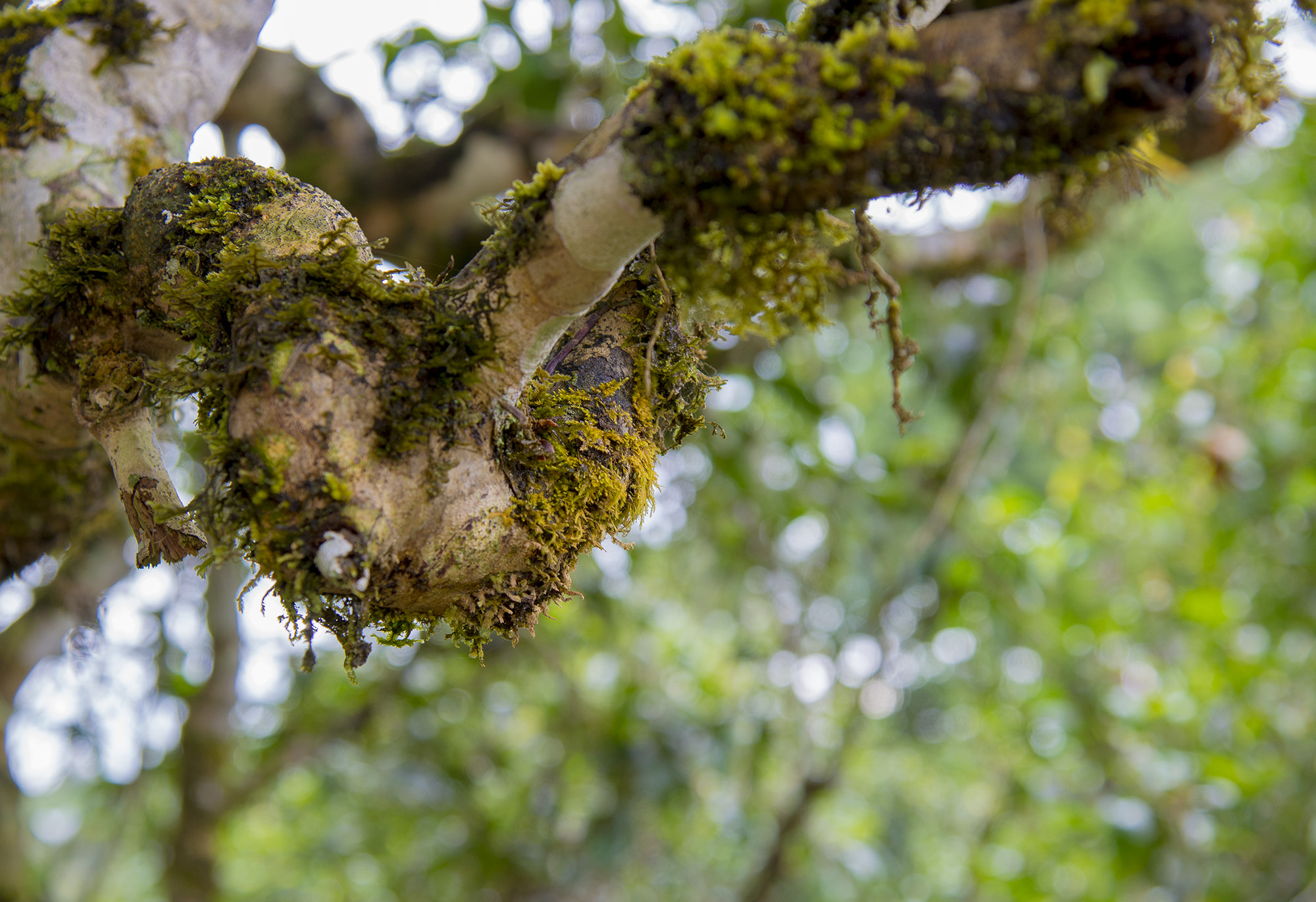
Moss on tea tree
One: Imagery.
Imagery is the overall feeling a tea gives us. It's like a young man seeing a girl and falling in love at first sight. He might not even know her name, but after seeing her once on the road, he has already imagined dating, marrying her, and even named their future children. If you ask him what she looks like, he says beautiful; ask for specifics, he can't say clearly, just beautiful; ask about her habits, where she's from, her hobbies, he doesn't know, but he likes her anyway. Love at first sight that lasts a lifetime is the ultimate beauty in the world.
Tea is the same.
When I drink tea, I mainly focus on imagery. Tea with good imagery usually has good taste; tea with poor imagery, even if the taste is good, the body sensation is lacking, and some even have poor taste and body sensation. I have always believed that only tea with good imagery is worth drinking. For those of us who make mid-to-high-end tea, such tea deserves attention.
When I taste tea, I often discard it after one infusion. Some think I'm being pretentious, as the first infusion hasn't even released its full flavor. But I'm actually drinking the imagery; one infusion is enough. The taste might change, but if the initial imagery is poor, there's no point in continuing.
This overall feeling requires a calm body. Tea can speak, but only if you can understand it. For a calm body, please refer to my 2022 video "How to Understand Tea? Advanced Level". Besides a calm body, you need to empty yourself, not deliberately focus on the taste, forget the tea knowledge you've learned, forget those damn technical terms, and feel the tea with an ethereal mindset. Have you noticed that children are particularly accurate when tasting tea? Because their bodies are calm, they don't know about tea, they only care if it tastes good. Good or not is the most common imagery.
At this point, skeptics might ask: then haven't all those professional tea makers and graceful tea artists wasted their knowledge? No! Learning tea is a process from one to many, and then back to one. If you can't return to one, I think you need to learn more; there is huge room for improvement. I've seen people who have been making tea for decades but still don't understand it. Persistence is useless; why not empty yourself, go out more, take a break from studying tea, sleep well, eat simple meals, and maybe one day you'll have an epiphany. That's how I understood it!
In fact, many people have imagery. For example, drinking tea with a smoky flavor might evoke the feeling of eating bacon; some unclean tea might taste like pig feed; often people say drinking a certain tea makes them unhappy, while another has the taste of first love. These are the most basic forms of imagery. Forget professional knowledge, let's use our bodies to perceive tea, to seek the beauty (or ugliness) at the moment the tea soup enters the mouth.
Let me share my imagery. First, the good feelings: like a spring breeze; like walking in a primeval forest, having eaten ginseng fruit, with every pore open; cool, like a sudden drizzle at noon in the scorching summer; crisp and sweet, like when I was a child, chopping wood on the mountain, thirsty and hot, finding a clear spring, and drinking with my hands, feeling the coolness penetrating the heart, with a hint of sweetness; this tea relieves stress; this tea broadens the mind; this tea is like mellow wine; this tea has the taste of mother's cooking, etc. The bad feelings are probably similar for all of us: pig feed, entering a garbage dump, dust, cheap perfume, etc.
Two: Quenching Thirst.
Tea is first a beverage, a substitute for water. Seasoned tea lovers, please remember this sentence:
Tea is water, but it cannot completely replace water.Besides tea, we should still drink plenty of water—boiled water, mineral water, or purified water.
Since it's a substitute for water, quenching thirst becomes a necessary condition. Unfortunately, many teas don't quench thirst, and some even make you thirstier. If you encounter tea that you can't drink or that makes you thirsty, stay away.
We don't need others to teach us how to drink tea; tea that quenches thirst is basically enough.
Only after quenching thirst is it necessary to pay attention to other aspects of tea.
Three: Taste.
Regarding taste, I've made many videos, so I won't expand here; I'll just briefly note it to keep the article complete.
1. Aroma.
There are three types of aroma: aroma in the air is worthless, as is aroma on the cup; only aroma in the soup is valuable. Some teas smell fragrant when brewed, but once in the mouth, they're garbage. Teas of slightly decent quality have good cup aroma, so cup aroma has no reference value. Aroma in the soup, where the fragrance enters the water, when you hold the tea soup in your mouth, a subtle fragrance fills the mouth and penetrates the heart and spleen. Only aroma in the soup is the true way. Air and cup aromas fade quickly, but soup aroma lasts.
Refinement of aroma. A subtle, lingering aroma is best; a pungent one is inferior. Fine aroma is light, faint, seemingly present yet absent, like being entwined in a passionate love; poor aroma is intense and direct, like cheap perfume, making your nose itch and sneeze. If a woman at the east end of the village uses such perfume, people at the west end would still be irritated. Fine aroma is like floral and fruity scents; coarse aroma is like artificial flavoring. Good tea should have all three aromas excellent. So far, I haven't seen tea with good soup aroma but poor air and cup aromas.
2. Sweetness.
Clear sweetness is entry-level; from clear sweetness to crisp sweetness is the highest level of sweetness. Why are Yiwu tea and Bingdao tea so popular? One of the main reasons is that they start with clear sweetness and peak with crisp sweetness. Clear sweetness becomes more appealing as you drink; cloying sweetness is hard to swallow. Good tea should be clear and sweet, even crisp.
Sweetness is easy to understand. Natural fruit sweetness is mostly clear; maltose and birthday cake sweetness are often not. As for sweetness reaching crispness, buy some natural mineral water, taste it carefully, and find the subtle, almost absent sweetness and crispness.
3. Flavor.
Clean flavor is the most important. Only through control in processing and selection of raw materials can clean tea be made. Unclean tea will only have poor imagery.
Good tea should have a complete flavor, a complete mouthfeel, and throat resonance. Tea with incomplete mouthfeel or emptiness tends to make you thirstier as you drink.
Good tea soup should be like a gentleman, warm and smooth like jade. Smoothness is not just thickness; it's the fullness and firmness of the tea soup. Loose, watery tea soup is not appealing.
Tea soup should be soft. The soft power of tea refers to this. The hardest things are not cut with diamonds but with water. Soft, smooth tea soup aligns with the principles of health, so such tea can be drunk in quantity.
When entering the mouth, there should be a subtle fragrance and clear sweetness; when held in the mouth, the tea soup should be full, with good saliva production and aftertaste; when swallowed, the aftertaste should be endless. Only when these three aspects are combined can it be considered good tea.
4. Resonance.
Rock tea emphasizes "cong flavor," Pu-erh emphasizes "wild mountain resonance." They all refer to the same thing: resonance.
Good tea must be full of resonance, with a taste of the wild mountains that you can actually perceive, a taste of nature. That's what it means.
Free-range chicken is especially fragrant; compared to supermarket broiler chicken, the main difference is resonance.
Tea with strong resonance must come from a good ecosystem. Of course, a good ecosystem doesn't just mean free-range; reasonable organic fertilizer and pesticides can also produce tea full of resonance.
5. Liveliness.
Aroma, sweetness, resonance, and liveliness are my five indicators for evaluating tea. See: /lcpf.html.
I will write a separate article on liveliness, which will be the next one, "The Art of Drinking Tea for a Comfortable Body: Body Sensation."
Four: Summary.
Good tea often has no obvious shortcomings; aroma, sweetness, resonance, and liveliness should all be very good. It should taste good regardless of whether it's brewed by a professional tea artist, whether the water temperature is lowered, or whether the infusion time is fast or slow.
Learn to drink tea with your mouth. Don't think a tea is good just because it's expensive, made by a famous person, or from a famous mountain. That's drinking with your eyes and ears, not your mouth.
Everyone has the ability to discern tea. Trust yourself. Of course, appropriate learning and discussion are necessary, but no matter what others say, if you feel uncomfortable with a tea, you should trust your feelings and stay away from that tea, or even that person (company).
Paragraph comments 0 · moderated
Comments 0 · moderated