
Note: This is a record made in 2022 for tea talks, which has been kept as a draft for going out to talk about tea. In recent years, there has been no place to go to talk about tea. If I don't publish it again, the ink will fade. I won't revise it, just publish it directly and put it in the series of 'Tea Talk on Paper'. This is the thirty-third article in my Tea Talk on Paper series. Click to read more Tea Talk on Paper articles.
I am Lü Jianfeng. In 2008, I founded 51 Pu'er Net, which was doing quite well at the time. In 2011, I started making tea under my own brand, called Zhongmu. I have made over a hundred teas since then, and I am still launching new products. In 2015, I started crowdfunding tea and founded the brand Houyue. In 2018, I went to Dehong and co-founded Dehong Ancient Tea with Teacher Shi Yilong. I have been making tea for 13 years and am still learning. I welcome all teachers to give me advice. I have written a series of articles called 'Tea Talk on Paper', among which the sub-series 'Biographies of Tea People' is widely spread and is still being updated. I have also made a series of videos called 'Lao Lü Talks Tea', in which I try to explain my understanding of tea. There are over a hundred videos, and I am also planning to update them recently. They are all available on the 'Lao Lü Talks Tea' official account. You are welcome to learn more.
Let's first look at a set of data:
In 2021, data from Yunnan forestry departments showed that Yunnan's forest land area is 424 million mu! Yunnan's forest coverage rate exceeds 65%. What about the whole country? 23%. Let's look at Fujian and Zhejiang again. Fujian ranks first in the country, also exceeding 65%, and Zhejiang is 61%. You see, the main tea-producing areas all have high forest coverage rates. The province with the largest tea planting area in our country is Guizhou, with over 7 million mu, and it is said that it will soon break through 10 million mu. Guizhou's forest coverage rate also exceeds 60%. Will the next hot spot be Guizhou tea? Through forest coverage rates, I lead to my point today:
The Ecological Beauty of Yunnan Ancient Tree Tea!
Next, let's talk about today's topic.
I. Tea Culture of Yunnan Ethnic Minorities
1. The Slash-and-Burn Cultivation of the Hani People
I know quite a lot about the Hani people, not from books, but from chatting with some Hani people, especially some elderly people. Hani men do not go out to work; they stay at home to take care of children. There is a reason for this. The Dai people in Menghai live at the foot of the mountains, while the Hani, Lahu, and Blang people mostly live on the mountains. This is determined by strength. For example, if the Hani people have a particularly good village, and the Dai people like it, the Dai people will make the Hani people move away, because the Dai people want to live in that village. Unlike now, there was no rule of law at that time; only strength decided everything. The Dai were the absolute kings, so the Hani people could only move up the mountains, because the suitable living places were occupied by others. The Hani people lived a slash-and-burn life, such as planting grain. They would burn the mountains and then plant crops. After a few years, when the land lost fertility, they would find a new place and burn again. These tasks were done by men. They would gather together to find suitable land for planting grain, which might be on the other side of the mountain, requiring several days of walking. These people would not return until the grain was harvested. Those left in the village were women, taking care of children and cooking. When the men returned, the household chores were still done by women, and the men just took care of the children. For example, hunting was also done in groups. Those with men counted as labor, and those without could contribute dogs. After the hunt, the prey was divided according to contribution; of course, dogs got a smaller share.
2. The Ancient Tea People: The Blang People
Academia generally recognizes that the Blang people are one of the earliest tea-planting ethnic groups in Yunnan, and some say they were the first to plant and drink tea. According to the 'Guangnan County Annals', in the 5th century BC, tribes mainly composed of Liao and Pu formed the Jutong Kingdom, which was rich in tea. The Blang people also practiced slash-and-burn cultivation, like the Hani, but they also mainly planted tea. They would find suitable mountain land near the village, burn the land, sow tea seeds, and tea would grow. As the land around the village became less suitable for grain, they would need to move to a new place closer to grain-growing land, abandoning the tea trees of the previous village and planting new tea trees near the new village. Thus, patches of ancient tea trees appeared in the mountains. This is also the reason why in the past decade or so, new plots like Mintang have been continuously discovered in deep forests such as state-owned forests.
3. The De'ang People, Who Cannot Do Without Tea
I came into contact with the De'ang people in Dehong. I believe the De'ang people should be a branch of the Blang people, as they have too many similarities. Of course, I am not an expert in this field, so I won't say much. The life of the De'ang people cannot be separated from tea. Customs such as 'birth tea', 'adult tea', 'gathering tea', 'social tea', 'love tea', and 'engagement tea' almost always accompany the life journey of every De'ang person. The De'ang people also plant tea trees around the village, in front of and behind their houses. When the village moves, they plant tea in the new village. During our investigations in Dehong, we found that many ancient tea trees in villages, including those of the Dai, Jingpo, Achang, and Lisu people, were very likely planted by the De'ang people in the past.
4. Tea Customs of Ethnic Minorities
When I was in the Menghai tea mountains, the local tea farmers liked to roast tea before drinking. They would roast the tea until it was slightly burnt, then pour boiling water. The taste was good, with a burnt aroma mixed with the tea's fragrance. The most famous roasted tea is in Dali, where the Bai and Yi people love roasted tea the most. The special clay pots for roasting tea are mostly made in Dali. Dehong and Baoshan also have tea-drinking habits, but they mostly drink green tea, also baked until slightly burnt, such as Mogo tea and Huilong tea.
This is about drinking tea, and there is also eating tea. Laobanzhang's tea-leaf eggs cost 88 yuan per plate, and everyone who goes there likes to order one. Tea leaves are used to make pickled vegetables, and tea leaves are stir-fried with various dishes. Ethnic minorities have always been eating tea leaves. The De'ang people's sour tea, I believe, evolved from tea-leaf pickles.
5. Summary
The ethnic minorities in Yunnan have always been planting, drinking, and eating tea. By understanding the customs of these minorities, we can roughly conclude that most of Yunnan's ancient tree teas were planted by minorities such as the Blang and De'ang. Later, with tea trade, various ethnic groups, including the Han, began to plant tea. These teas are what we call ancient tree tea today.
II. How Ancient Tree Tea Has Been Preserved
Have you ever heard of 'head-chopping tea'?
'Head-chopping tea' has a long history. As early as 1953, experiments were first conducted in Nannuo Mountain, Menghai. Later, in Manzhen Village, 50 mu were dwarfed, which was called the low-yield tea transformation experiment.
From the name of the experiment, we can see that the purpose of dwarfing ancient tea trees was to increase tea production. Ancient tea trees that were not dwarfed mostly had only one to three trunks, growing taller and taller with a small canopy, producing very limited tea. Moreover, as they aged, they would gradually senesce, with weakened sprouting ability, until they eventually could not produce new shoots.
At this point, the tea tree would be dwarfed by cutting off the main trunk at about 20 cm above the ground, causing three to four or up to a dozen new shoots to sprout, growing into new branches, increasing the canopy and tea production. The transformation methods mainly included ring barking, stool cutting, heavy pruning, and light pruning.
What were the effects of the transformation? According to survey data from the Menghai tea department, the yield of ancient tea trees before transformation was 12.5 kg per mu, and after transformation, the maximum yield could reach 169 kg per mu, an increase of more than tenfold.
In the late 1980s and early 1990s, the national agriculture, forestry, and trade departments asked Yunnan Province to select eight export base counties, and tea demand increased significantly. Thus, starting from Menghai, many ancient tea gardens were subjected to 'head-chopping' transformation. Therefore, the ancient tea trees seen today in Yiwu and many areas of Menghai have new branches that are only about 30 years old.
When mentioning head-chopping tea, we must talk about Yunnan's ethnic minorities again. Before 2000, Laobanzhang tea was large and black, and it was much cheaper than tea from other parts of Bulang Mountain. Many Laobanzhang teas even had to be disguised as teas from other places to be sold. The Han and Dai people are particularly diligent and obedient. When the government organized the dwarfing of ancient tea trees, that is, head-chopping, they implemented it very thoroughly. Some even cut down all the trees and planted new ones, resulting in high yields. However, the Hani, Lahu, Blang, and other minorities did not have the concept of diligence. They relied on nature, and had no concept of saving money. In the great mountains of Yunnan, it is said that if you stick a carrying pole in the ground, it will grow into a tree the next year. Resources are abundant, which has fostered a lazy character among these peoples. For example, when the government distributed free fertilizer and saplings, they would sell them cheaply and use the money to buy wine to drink at home. It is because of the laziness of these minorities that we have the large-scale ancient tea gardens we see today. This is also the reason why Dai villages rarely have large areas of ancient tea trees.
III. Why Are Ancient Tree Teas So Popular?
Nowadays, many tea enthusiasts refuse to buy or drink anything but ancient tree tea. They demand teas from trees of a certain age, from famous mountains. For a time, the prices of famous mountain teas soared, and even non-famous ancient tree teas exceeded 1,000 yuan per kilogram. Bingdao Old Village tea rose from about 200 yuan in 2009 to about 80,000 yuan today, a huge increase. The tea farmers are also very proud and may not even sell to you. Why are ancient tree teas so popular? Let me analyze.
1. Low pesticide residues, safe.
Ancient tea trees grow on big mountains, and they are tree-shaped. The spacing between trees is generally more than 2 meters. Terrace tea gardens have more than 2,000 tea trees per mu, but ancient tea gardens have only a dozen or so per mu, with few even having dozens, and some even have only a few trees per mu. Moreover, ancient tea trees are very old. As we know, only trees over a hundred years old can be called ancient tea trees. Over the long years, these trees have experienced various weather conditions, even fires, and have survived. They do not need much human intervention, nor do they need pesticides or fertilizers to thrive. From a food safety perspective, ancient tea trees are more secure.
2. The taste is softer and sweeter, with good charm.
Let's look at the phenol-ammonia ratio data. According to the paper 'Comparative Study on Quality of Famous Mountain Ancient Tree Teas in Different Tea Areas of Yunnan' by experts such as Pu Shaoliu from the Menghai Tea Research Institute in 2019, the phenol-ammonia ratios of ancient tree teas in Menghai, Mengla (the six ancient tea mountains), and Shuangjiang Bingdao tea areas are all around 3-5, as shown in the figure below:
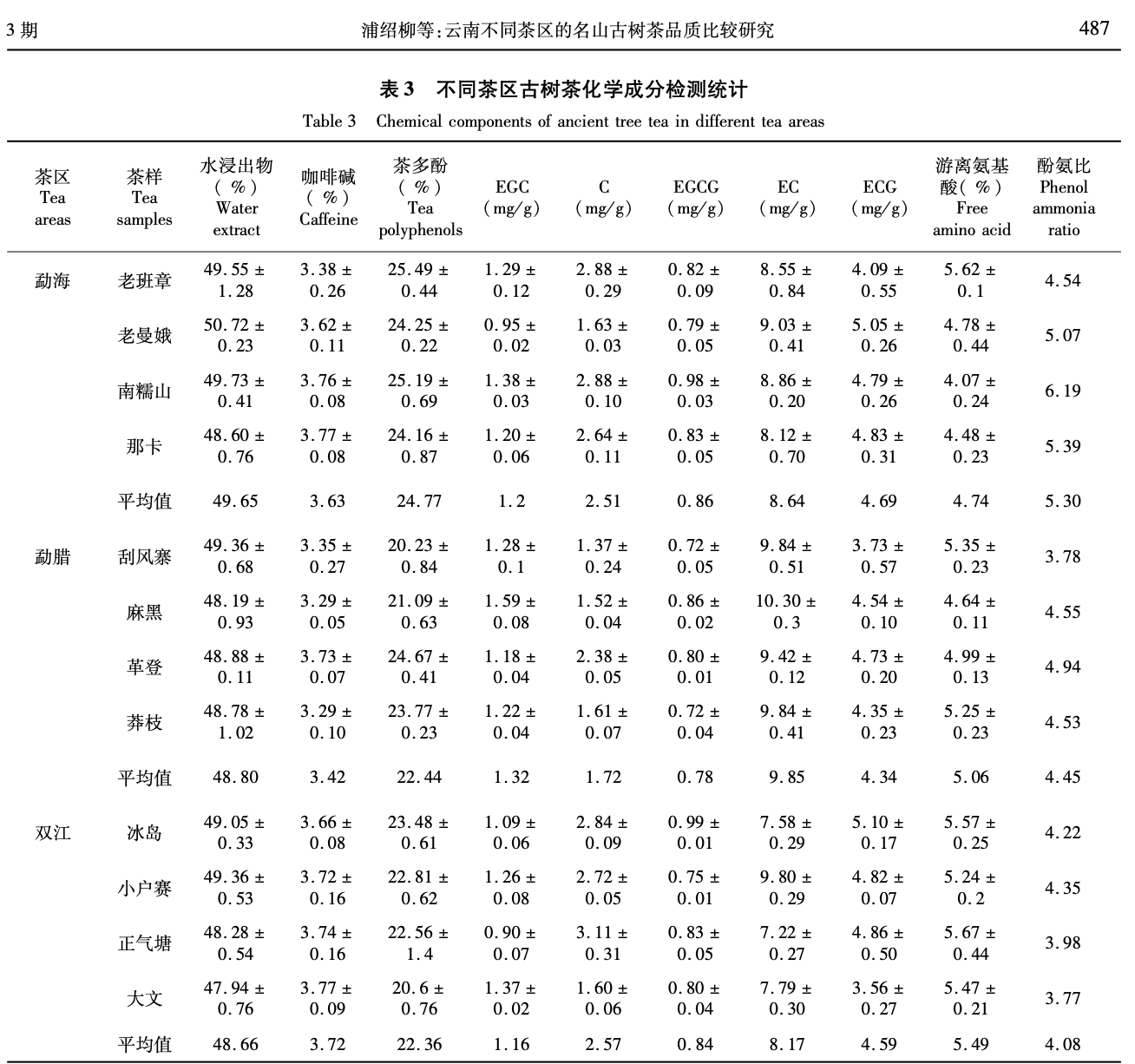
In Zhou Hongjie's 'Yunnan Pu'er Tea', p.26, the phenol-ammonia ratio of Yunkang No. 10 is 10.94; in Cheng Qikun's 'Tea Chemistry Analysis', p.42, the phenol-ammonia ratio of Yunnan large-leaf improved varieties, that is, small-tree tea, is 18.30. We know that the higher the phenol-ammonia ratio, the more bitter and astringent the tea tastes; the lower the ratio, the fresher and sweeter the tea. Regarding the taste of ancient tree tea, I have written an article, 'Tea Talk on Paper' No. 15: The Light Tea Life of Yunnan Ancient Tree Tea. Those interested can go and read it.
In general, ancient tree tea tastes better.
3. Wild mountain flavor
We humans all came from nature and forests, and forests carry a familiar and comfortable aura. For example, free-range chicken, no matter how you cook it, even just boiled in water, is very delicious. The chicken from the market is best for spicy chicken; if you make soup with it, you probably can't drink it. Tea from the forest has a similar aura, which I believe is the wild mountain charm. This is also the reason why our Houyue slogan uses 'Big Tree Tea from the Forest'. A tea garden with good ecology should be in the forest, with good taste, smooth body sensation, and a charming wild mountain aura.
4. Under the context of Pu'er tea's 'more fragrant with age', a new way of tasting tea.
When I first entered the industry in 2008, 'more fragrant with age' was the mainstream, and ancient tree tea was rarely mentioned. The market mainly drank old tea, and new tea was bought for storage. I have drunk many old teas, such as 88 Qing, various mark teas, real and fake, from various masters. I have drunk over a thousand kinds, and it is really hard to find ones I like. The aged aroma, separated from moldy smell by a thin line, is rarely pure, and most make me very uncomfortable, including many old teas today. Of course, I didn't understand tea at that time. It was not until 2013 that I started to come into contact with ancient tree tea. That subtle fragrance and clear sweetness made me fall in love immediately. I realized that besides old tea and 'more fragrant with age', Pu'er tea can also be drunk this way, with such a taste.
The emergence of ancient tree tea has provided a substitute for many high-end green tea drinkers. High-end green tea is seasonal and not suitable for excessive drinking, but ancient tree Pu'er is different. It can be brewed one infusion after another, can be drunk for a long time, and different mountains have different flavors. Coupled with the cultural output of ethnic minorities, the singing and dancing minorities, the generous minority girls, and the ancient tea trees deep in the mountains are all excellent accompaniments to tea. In addition, ancient tree tea has good taste, rich charm, and is safe to drink, making these tea enthusiasts unable to put down their cups. These enthusiasts have influenced more people around them.
5. Expensive, and the endorsement of enthusiasts.
Every spring tea season, I am in the tea areas. I also go to Laobanzhang and Bingdao Old Village, often taking friends. Many times, there is no place to park. I estimate that there are tens of thousands of tourists every day, all outsiders attracted by reputation. The charm of tea is really too great! These enthusiasts will definitely post on social media when they come to the tea mountains, and after returning, they will mostly show off the Laobanzhang or Bingdao tea they bought. Some even invite a few friends to hold tasting sessions. Word-of-mouth has thus become the main driving force for the rise of ancient tree Pu'er tea.
Famous mountain teas taste good, have great reputations, and many people buy them. The production is limited, so prices keep rising. Expensiveness is another driving force. Have you noticed that being expensive is a huge promotion? For example, I started to come into contact with Bitcoin in 2012 and recommended it to people around me, but few bought it then. Recently, I have found many people buying it. When asked, they said it was because the price of Bitcoin reached $30,000, which made them pay attention and start buying. Because it is expensive, they know and affirm its value. As a side note, when I did crowdfunding tea in 2015, I sold all my Bitcoin, and now I regret it deeply. We probably don't buy LV, right? The super rich can ignore this, but we all know LV. Why? Because LV is expensive. When Bingdao tea exceeded 10,000 yuan per kilogram, there was no need for publicity. Bingdao tea would only be in short supply and become more expensive.
Having talked about the good aspects of ancient tree tea, let me now talk about the chaos in ancient tree tea.
IV. Chaos in Ancient Tree Tea
1. Tree age
Regarding tree age, I have written two articles, 'Tea Talk on Paper' No. 2: The Temptation of Tree Age 1, and 'Tea Talk on Paper' No. 9: The Temptation of Tree Age 2. Those interested can go and read them.
Ancient tree tea refers to arbor tea that has survived for more than a hundred years, but this is difficult to identify, so there is a big market for tree age fraud. For example, the Hekai King Tea Tree is Xibao No. 4, meaning it is the fourth protected ancient tea tree in Xishuangbanna. The first time I went to see it, the introduction said its tree age was over 400 years. Later, when I went again, it was over 800 years. Now it is over 1,200 years. In less than ten years, this tree has grown 800 years older. What is ridiculous is that the Nannuo Mountain King Tea Tree is currently the longest-surviving ancient tea tree identified, as the Bada one has died. The official introduction of this Nannuo Mountain King Tea Tree is only over 800 years. Of course, this Nannuo Mountain King Tea Tree is not the one that was investigated and verified at that time. I have seen that tree; it died once, the main trunk died, and it grew out from the side.
Such king tea trees are openly fraudulent, so what about other tea trees? Those former small-tree teas, as long as the tree looks somewhat old, have all been promoted to ancient tree tea.
2. Counterfeit ancient tree tea
That is, you are shown ancient tree tea, but what is sold to you is small-tree tea; the cotton paper says ancient tree tea, but it is actually terrace tea. This phenomenon is widespread. Look at Taobao and Pinduoduo: Laobanzhang and Bingdao teas are sold for ten or twenty yuan, with many listings, and they sell very well.
3. Counterfeit famous mountains
It is said that the cotton paper in the Pu'er tea industry is divided into two categories: half is for Laobanzhang and Bingdao, and the other half is for other teas. But the total production of Laobanzhang and Bingdao is only about a hundred tons, which is negligible compared to the total 200,000 tons of Pu'er tea. Yet the amount of cotton paper is so large, which shows the craziness of counterfeiting famous tea mountains. The above-mentioned online sales are high, and physical stores are the same. Almost all Pu'er tea shops sell Bingdao and Laobanzhang. In Lijiang Old Town, a bundle of Laobanzhang is sold for just over a hundred yuan. When giving gifts, if you don't give Laobanzhang or Bingdao Pu'er, you feel embarrassed.
4. Existing famous mountains are showing a trend of deteriorating quality
Before 2012, when I went to Laobanzhang, starting from the Dai village Manhana at the foot of Hekai Mountain, passing through Hekai Manmai, Mannong, Banpen, and then to Laobanzhang, the whole road was forest. Now, when I go, the road is lined with bare mountains and large tea gardens. Taking Laobanzhang as an example, before 2015, the total tea production of Laobanzhang, including small-tree tea, was less than 50 tons. Now, according to incomplete statistics, the newly planted tea gardens exceed 100,000 mu, and the total production of Laobanzhang has exceeded 500 tons. Forest retreats, tea advances. Without forest, Laobanzhang is becoming less and less tasty, which is a trend. This is also why I have been selecting land for Laobanzhang tea.
Now look at Bingdao, it is actually the same. Because tea prices are so high, everyone is opening up mountains to plant tea. If big trees cannot be cut down, they strip the bark. Production has increased, but what about quality?
Famous mountain teas have a trend of deteriorating quality. When we tea makers discuss this, we often worry, but I have a heart toward the bright moon, yet the bright moon shines on money.
V. New Opportunities
The development of everything follows a parabola, whether it is ancient tree tea or famous ancient tree mountains. Famous mountains like Laobanzhang will still be pearls, but new tea mountains, because their ecology has not been destroyed, will become rising stars. Of course, the market will also force famous mountains like Laobanzhang and Bingdao to return to the focus of ecology. Recently, isn't Bingdao Old Village relocating the entire village? Letting tea gardens return to the forest is the general trend.
This is the reason I went to Dehong. Dehong's forest coverage rate exceeds 70%, and it is increasing year by year. Many tea gardens in Dehong are in a semi-abandoned state. To pick tea, you need to tread through grass and push aside other trees. The tea tastes very good, and with one sip, the wild mountain flavor hits you.
We are also looking for more places, such as returning to Yiwu to find tea in various forests. We are also pleasantly surprised to see that more and more tea farmers, under the guidance of the government, are paying more attention to ecology. I believe the future of ancient tree tea will definitely get better and better.
VI. Can Upgraded Terrace Tea Gardens Become Good Ancient Tree Tea?
People often ask this question, and my answer is affirmative. I have visited many such tea gardens and made samples. The conclusion is that by thinning terrace tea gardens from more than 2,000 trees per mu to dozens, and planting trees in and around the garden to restore the forest state, after more than ten years, the quality will be greatly improved. If given time, such as decades later, when the small-area ecology is fully restored, this tea garden will be a proper ancient tree tea garden in terms of both form and tea quality.
VII. What I Consider Good Tea
Regarding this, I have written an article, 'Tea Talk on Paper' No. 14: Ten Indicators of Ancient Tree Ripe Tea. That article is about ancient tree ripe tea, but it actually reflects my entire understanding of ancient tree tea. My tasting does not distinguish by tea category.
I have been making tea for 13 years and learning tea for 13 years. The tea I consider good is also the tea I drink every day. It has several characteristics, which I will share with you.
1. It must be smooth.
That is, when the tea soup enters the body, it should be smooth, like pouring a cup of water into sand, dispersing immediately. This permeability makes people feel particularly comfortable. Drinking tea can reduce stress and expand the chest, which is roughly what smoothness means.
The opposite of smoothness is stagnation, commonly manifested as stomach bloating, dizziness, and body weakness. I don't know if you have had such feelings. Smoothness requires more drinking and more experience.
Smoothness is the first important indicator I consider. If the ecology is not good, I have never tasted smooth tea. If tea is not smooth, no matter how good the taste, it is empty.
2. Complete mouthfeel
I divide the mouthfeel into three sections: the front of the mouth, the middle and back of the mouth, and the throat. This is easy to understand. Some teas, after drinking, only have sensation in the front of the mouth, and the rest is empty. Some good teas have sensation in both the front and back of the mouth, and even the throat feels cool. This is what people often call throat charm. Such tea has a relatively complete mouthfeel.
Another meaning of complete mouthfeel is what I call: entry, lingering, and residence. Some teas are okay on entry, but the lingering sensation is astringent, rough, or even numb, making you not want to drink more. After more than ten minutes, the mouth still feels tight, and you feel increasingly thirsty. This is extremely poor residence. Good tea should be good in all three aspects: sweet on entry, good saliva production and sweet aftertaste, and on the way back after drinking, the mouth feels cool, and the throat is comfortable, making you want to go back and have another cup. This is tea with very good residence.
Tea with complete mouthfeel should have a complete sensation in the mouth and complete in all three aspects.
3. Soup texture and aroma
The tea soup I like should be round and full, not necessarily fine, but without a prickly feeling. The tea soup should be smooth, have thickness, and a long aftertaste.
The temperature of the tea soup does not refer to water temperature, but the feeling the tea soup gives us. It is difficult to drink hot water in large mouthfuls because it is scalding, but tea can be drunk. This is the problem that tea soup brings us. Good tea tends to be cooler, so it can be drunk while hot. At the same temperature, some teas feel hotter than drinking water. I think such teas are not good.
The aroma of tea should be subtle, with fragrance in the water. Aroma also has temperature. Hot-aroma teas are like poor baked black tea, too pungent and direct; I don't like them. Cool tea aromas, like the best Mintang or Yibang ancient tree tea, are subtle and cool, like orchid fragrance or gardenia, intoxicating.
4. Strong wild mountain flavor
Wild mountain flavor can be understood intuitively, but it can also be described. Let's talk about free-range chicken again. It is easy to distinguish from market chicken. If we test it, I believe many indicators of free-range chicken and market chicken are similar. The difference lies in this flavor, and the feeling is completely different. This flavor in tea is the wild mountain flavor. When we taste the flavor of nature in the tea soup, tea with strong wild mountain flavor, when drunk, makes our mouth feel pleasant and our body relaxed, as if there is a particularly captivating feeling in the tea soup. This feeling is the wild mountain flavor, which is captivating, making us drink cup after cup, feeling more and more comfortable.
Tea with good wild mountain flavor often brings good imagery.
5. Imagery
Imagery is easy to understand. Some people, when they see a girl, feel the urge to fall in love and start imagining dating, marriage, and children. This is imagery.
Regarding tea imagery, it is the subconscious feeling that tea drinking brings. The most common thing I hear is that they taste the flavor of the sun. This is a kind of charm. Tea has charm, and the charm makes the body joyful, and the body may present an image. Personally, I think imagery is the highest state of tea-drinking comfort. Some people have bad imagery with bad tea.
When I drink tea from the forest, I often feel as if I am walking in the forest, with big trees overhead, birds singing and insects chirping in my ears, and wet soil with wild grass underfoot. I have compared SGS test results, and teas that give this feeling have very good data. I used to tell these feelings to my peers, and many said I was bragging or a charlatan. Now I rarely say these things; I just quietly drink tea, make tea, and sell tea.
VIII. Finally, I raise a question: Is small-tree tea good?
I have done some comparative experiments. In the same area, ancient trees are indeed better than small trees. But in different areas, small trees in the forest are much better than ancient tea trees in cornfields or in front of and behind houses.
Houyue tea is divided into three levels: the highest is 'Pin Cang' (tasting and collection), the middle is 'Pin Jian' (tasting and appraisal), and the entry level is called 'Pin Yi' (tasting and discussion). Our crowdfunding teas are mostly at this level. There are now thirteen crowdfunding teas, and ten are at the drinking level. They are all blends of large and small trees. We also disclose this information in the product descriptions. Drinking-level ancient tree tea means it reaches the quality of ancient tree tea, but it is not necessarily pure ancient tree tea. This is my respect for small-tree tea, and it is Houyue tea's recognition of ecology.
I would rather have small trees with good ecology than ancient trees with bad ecology!
The greatest charm of Yunnan ancient tree tea is not the age of the trees, but that most of these ancient trees grow in the mountains, in the forests, and that the ecology is good.
IX. Summary
Drinking ancient tree tea is drinking ecology. Only with good ecology can there be good tea. Yunnan has more than 6 million mu of tea gardens, many of which are undergoing ecological upgrades. Most of these are not good tea now, but in the near future, with forest coverage and ecological improvement, they will all become good tea.
Paragraph comments 0 · moderated
Comments 0 · moderated