
This original article was written on September 8, 2015. Original source: https://www.51puer.com/This crowdfunding tea is the Liushan Bing (China's first crowdfunded ancient tree tea)
##
Never has a tea made me so anxious!
In one week, 66 people participated, and 740,000 yuan was raised. The fundraising went very smoothly, and I was in high spirits, but then the raw material poured a bucket of water on me that was below minus ten degrees Celsius but somehow didn't freeze, chilling me to the bone.
Can't find suitable raw material!
During the crowdfunding process, we started collecting information on raw materials. Teacher Huang and I asked tea merchants and material suppliers we had worked with for samples and prices. Later, whenever we heard someone had raw material from the Six Ancient Tea Mountains, we rushed over to verify. The results were either the tea wasn't suitable, didn't meet Teacher Huang's quality and ecological requirements, or the price was too high, often double or more than our budget. By the second week after the crowdfunding ended, we hadn't found anything suitable. All sorts of comments filled my ears: that it was impossible, that we couldn't find the tea we wanted at that cost, urging us to lower our quality requirements, make a smaller quantity, or refund the money, saying a real man knows when to bend. Some even spread rumors with gloating eyes, waiting to see me fail.
If we can't find it in Kunming, we go to the mountains!
In early April this year, I bought nearly 2 tons of Yiwu tea in Yiwu. At that time, I learned that the situation in the entire Yiwu tea area was not optimistic this year. Many large buyers from previous years were gone, so I thought there should be plenty of tea still unsold in the mountains.
On July 22nd, several core members of our group in Kunming met at the Gu Pu Hui. The atmosphere was quite heavy. I suggested that I lead a team to go directly to the tea mountains to check the inventory of tea farmers and material suppliers. Teacher Huang also felt we should go, but because we were looking for spring tea at this time, and the quantity was quite large, he advised not to make it public, to go quietly, first contact material suppliers, then tea farmers, and especially not to post on social media or reveal that I was Lü Jianfeng from 51puer.com, as many Yiwu tea resource people already knew I had initiated this crowdfunding tea and was looking for raw materials. Others added a few points, and finally, we reached a consensus on material selection as follows:
1. Reject pesticide residues;
- Scope locked to the Six Ancient Tea Mountains, especially rejecting Jiangcheng tea;
- Focus on this year's spring tea;
- Main material 1.8 tons, price per kilogram not exceeding *** yuan;
- The raw materials should be blended and pressed, with tea energy complementing each other, able to balance, and the base material should be versatile.
Finding people!
I started inviting a small circle of people, targeting experienced tea makers.
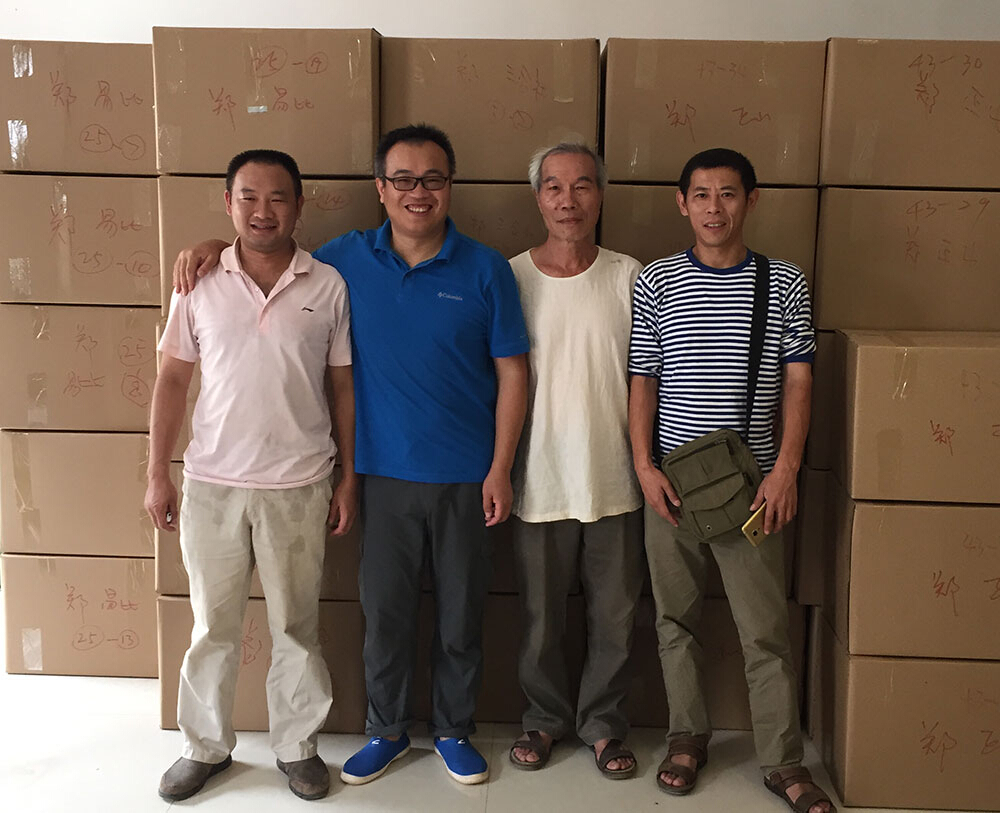
Our core member, Teacher Liang Xiangtian, came from Taiwan. Teacher Liang has worked in tea for nearly a lifetime, with footprints across all major tea areas in Yunnan, and knows Yiwu tea well. Another core member, Shen Li'en, is in Kunming. He and one of our VIP members, Zou Dazhi, have been going to the mountains to collect tea since 2009, both experienced tea merchants. As for me, I'm not exceptionally talented, not particularly handsome, but I've set foot on most tea mountains in Yunnan, visited Yiwu many times, and bought quite a bit of tea. However, I mostly observe from the surface and haven't studied deeply. But there's no choice; I had to go to make up the numbers. Teacher Huang stayed in Kunming. We sent the initially selected tea samples to him, and only when he confirmed they were qualified, usable, blendable, and added value did we proceed. Teacher Huang could also continue collecting tea samples from other channels in Kunming.
Trip to Menghai!
So, on August 3rd, our group of four first arrived in Menghai. Menghai is now a major town for Pu'er tea, the first distribution center for Pu'er raw material. Menghai not only has the Menghai Tea Factory and Lao Banzhang, but also several tea markets of considerable scale, with material merchants gathering in abundance. The major material suppliers I know are all in Menghai. We came to Menghai full of hope.
Once in Menghai, we started working. Before coming, we had already done a lot of groundwork, learning about material suppliers in Menghai who had tea from the Six Ancient Tea Mountains. On the first day, we looked at dozens of tea samples. After initial visual inspection, we selected about 20 samples to bring back, planning to brew them that evening.
That night, we were still quite excited. Our VIP member in Menghai, Mengsong Yu Wang, who had been in tea for over ten years, also came. The six of us used tasting cups to compare more than a dozen samples per round with the standard samples we brought from Kunming. After two rounds, we were very disappointed; basically, none met our standard sample level. We comforted each other, saying we'd keep looking and tomorrow would be better, and decided to visit Youle Mountain first.
On the 5th, during the day, we went from Menghai to Youle. Youle is the ancient name, one of the Six Ancient Tea Mountains, now known as Jinuo Mountain. In Youle, we found material suppliers, visited tea factories, surveyed several villages, and collected about ten tea samples before returning to Menghai. As usual, we brewed and evaluated them that evening. We didn't dare to be excited. During evaluation, we were quieter than the day before, quietly observing the soup color, smelling the leaves, tasting the soup, and finally quietly stating our conclusions.
Tomorrow wasn't better; the results were similar the day after, and the day after that. On the evening of the 7th, the four of us met and unanimously decided to go to Yiwu and look for tea directly at the source.
Impression of Yiwu!
I knew that among the Six Ancient Tea Mountains, Xiangming accounted for four, and Yiwu and Jinuo each had one. But personally, I believe the Six Ancient Tea Mountains are all in Yiwu, in the broader Yiwu tea area concept.
[
Why do I say this?
Let's talk about Youle first. Youle's glory is gone. To exaggerate a bit, it has the name of one of the Six Ancient Tea Mountains but not the reality. This trip, the worst craftsmanship and cheapest tea were seen in Youle. It's said, and I also believe, that some Yibang tea actually comes from Youle, to the point where it has to impersonate others to gain value. Youle's ecology is the most concerning; the densest rubber forests I've ever seen were in the Youle tea area. Of course, criticism is a reminder, a kind reminder. The reason for criticism is that we still have expectations for Youle, hoping they can improve their ecological awareness, hoping that in a few years we'll see some gratifying changes, hoping Youle remains Youle, at least a tea area worthy of its name.
Now let's talk about Xiangming. Geden, Yibang, Mangzhi, and Manzhuan of the Six Ancient Tea Mountains are all in Xiangming. We conducted in-depth research on these four mountains this time. The tea is good, the craftsmanship is good, and the ecology is also good, but I still agree with the broader Yiwu tea area concept.
First, commerce is in Yiwu. Traces of tea are everywhere in Yiwu town. Tea workshops and factories are everywhere. Even the owner of the Chazhiyuan Inn where we stayed had several rough processing facilities and a tea factory. Merchants buying tea from the Six Ancient Tea Mountains also choose Yiwu as their base to gather information.
Second, the culture of the Six Ancient Tea Mountains is in Yiwu. Mansha is the only tea mountain on the map that belongs to the Six Ancient Tea Mountains in Yiwu town, but Yiwu has a broad mind and pattern. It doesn't promote small Mansha but promotes the greater Yiwu, inheriting the past and promoting the present. Chen Sheng Fu Yuan Chang uses a new voice to tell the story of the old tea house Fu Yuan Chang on the ancient tea-horse road with the sound of horse hooves, past and present. Xiangyuan's small production area blueprint is increasingly clear. Boss Shi, who is the same age as me, and whose handsomeness is on par with mine, but because he dresses well and grooms himself, looks a bit more handsome than me, continues the glory of Song Pin Hao in Yiwu and Hangzhou. Yiwu Zhengshan has become a new brand for the Six Ancient Tea Mountains area today. Where is Yiwu Zhengshan? I don't know. Perhaps it's in the hearts of you, me, and consumers.
The Eternal Yiwu Tea
I've been in tea for nearly 7 years and often hear two phrases. The first is that Pu'er tea is the ultimate tea for tea drinkers. No matter what tea you start with, after many years or soon, you'll mainly drink Pu'er or only Pu'er. I have no right to speak on this without investigation. The second phrase is that Yiwu is unavoidable for tea makers and tea drinkers alike, roughly meaning that no matter how you circle around, Yiwu tea is still the best. I at least partially agree with this.
Banzhang is the king, Yiwu is the queen. I think this is the most successful advertising slogan in the tea world, bar none. Lao Banzhang is now at its peak, incredibly popular. Today, our focus is still on Yiwu, the "queen." Most of the aged teas that can be found today are from the Yiwu tea area; this is living history. Teacher Deng Shihai's phrase "the older, the more fragrant" is the cornerstone of the entire modern Pu'er tea system, and the evidence is likely based on aged Yiwu teas; this is also history. The Six Ancient Tea Mountains are famous, and the history of the ancient tea-horse road is an enlarged history of Yiwu tea. The long tea-horse road starts from Yiwu, step by step coming toward us. This is history.
Today's Yiwu doesn't rest on the ashes of history but innovates and stands independently in the tea world based on history. Yiwu's ecology is evident to all. Yiwu tea in the mountains, Yiwu tea in the forests. Today, Yiwu tea is fully connected with the world, conforming to the global trend of healthy, ecological food. High mountains, mist, and good tea are the result of Yiwu people's care for ecology and protection of ancient tea trees. The previous Pu'er craze was led by Yiwu tea, popular in Hong Kong and Taiwan. With the birth of the industry cornerstone "the older, the more fragrant," and its widespread hype to the point of being known by all, Pu'er tea became popular nationwide, leading to today's Pu'er situation.
A history of Yiwu tea is the history of Pu'er tea. How can you bypass history? This is my impression of Yiwu and the origin of this crowdfunding tea.
Yiwu's Soft Charm!
We tea makers often mention that a tea has an obvious Yiwu flavor. So, the question arises: what is Yiwu flavor?
Many people say Da Yi tea is good because it has a Menghai flavor. I once explored for a long time what Menghai flavor is, and I'll analyze it in another article if I have the chance. This crowdfunding tea has already excluded Youle from the Six Ancient Tea Mountains, leaving the broader Yiwu tea area. To make good tea, we must first understand what Yiwu flavor is.
"When you drink Yiwu tea, it feels like nothing much, not strong, soft, but with a great aftereffect." That day, we were tasting Yiwu tea samples at Kangle Tea City, and Mr. Yang from the Gongting Tea Factory said this. I strongly agree. The softest thing is water, but the highest good is like water. Yiwu tea is brewed with water, letting the water add more tea charm. My understanding of Yiwu flavor is Yiwu's soft charm. Another common description of Yiwu tea: the soup is fragrant and the water is smooth; this is just another interpretation of soft charm. Soft, but not weak in power, like a slender woman who looks fragile but holds up half the sky. "Soft with strength, strength with charm," this is my understanding of Yiwu's soft charm. Before departure, Teacher Huang also invited us several times to taste his collected Yiwu tea samples, repeatedly mentioning this "soft" character. Making an ancient tree tea with obvious Yiwu characteristics, that is, an obvious Yiwu flavor, was our consensus before departure.
Yiwu, here we come!
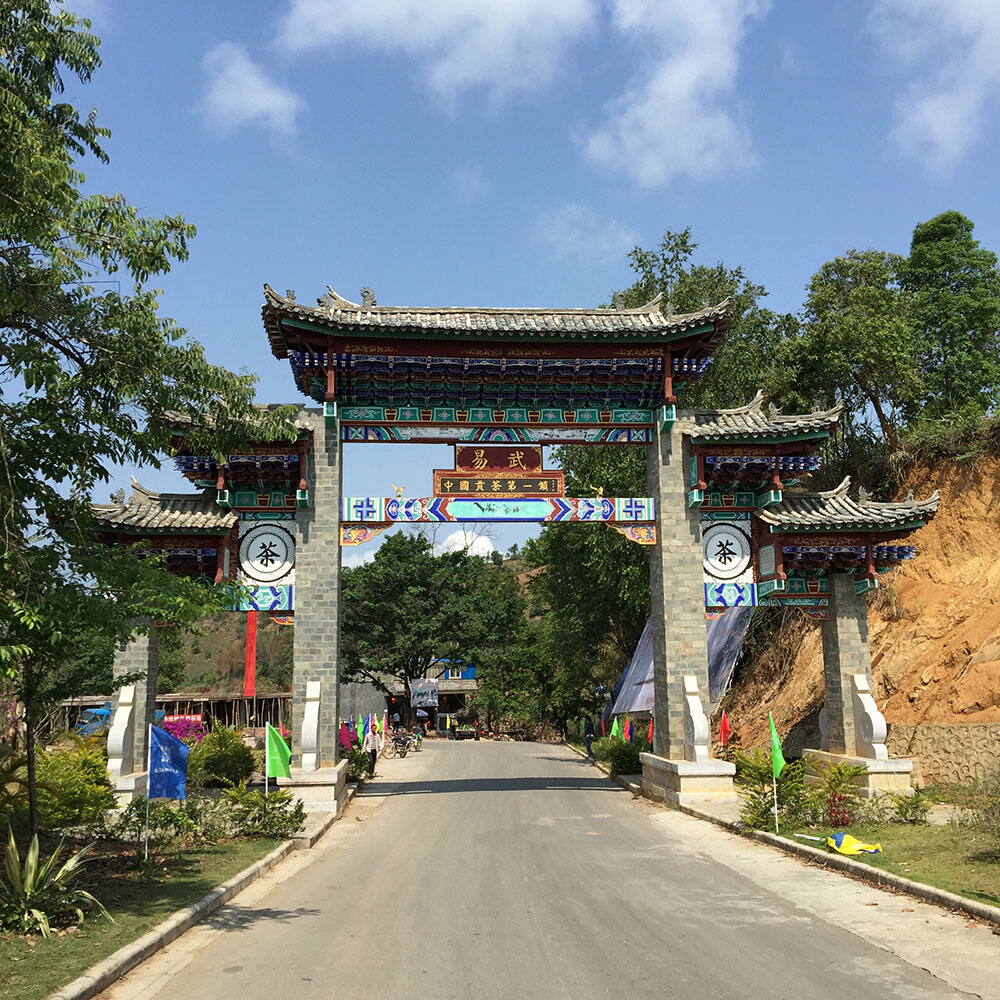
With the impression of Yiwu and understanding of Yiwu flavor, we arrived in Yiwu. We arrived very late, called for a long time to get into the Yiwu Inn. It's famous, but also has many ants. The next day, I insisted on changing accommodation. The 15-day Yiwu trip began with memories of ants.
We first paid respects to various docks, roughly going through the major tea merchants and material suppliers in Yiwu. The situation in Yiwu was much better than in Menghai. Tea farmers didn't have much spring tea left. In August, fresh leaves in many villages in Yiwu still cost dozens of yuan per kilogram, and some people were still buying.
We used Yiwu town as a base. We visited most of the famous tea-producing villages we could this time. The only ones we didn't visit were Guafeng Village and Yaoding (Yao ethnic Dingjia Village). We visited too many places; let me tell you slowly.
Setting the Base Material!
There are two types of raw Pu'er tea: single-origin, which is a single variety from a certain area, requiring the tea to have characteristics and quantity; and blended, which takes the strengths of various teas to compensate for weaknesses, with multiple materials blended by a blender to present a new taste and body sensation. Our tea quantity is 4 tons. With such a large quantity and at the wrong time, to find good tea that meets our requirements, we had to blend. Teacher Huang and Teacher Liang both mentioned that blending first requires a base material. Once the base material is secured, the rest is easier. The reason is that to blend, you need material to blend and know what to blend to add value. You need a base tea sample as a starting point and reference to find other teas. Blending is not simple mixing. A good product is naturally formed, and a clever hand occasionally obtains it; after all, it's not something you can always find.
We were quite lucky in finding the base material. We found two types with quantity and decent quality. We immediately sent them by SF Express to Teacher Huang in Kunming for a decision. The next day, Teacher Huang replied and settled on one, also giving us a plan. The base material had a moderate tea energy but lacked strength at both ends, the taste was mild and lacked intensity, and the aroma was slightly lacking. He told us to look for blending materials according to these directions.
We started getting excited again and immediately formulated a battle plan, mainly proposed by Teacher Liang:
1. The blending materials should mainly be first-picked spring tea; first-picked spring tea has strong taste and aroma;
2. Focus on the Yiwu Manzhuan direction, with Wan Gong area as a supplement; the reason is still the above two;
3. I was responsible for the ecology and body sensation of the raw materials, and the other three were responsible for taste; finally, we all evaluated whether it fused with the base material and whether the blend would improve.
Teacher Huang and I had been relearning tea drinking for over two months and had some understanding of tea energy and ecological body sensation. Normally, we should be far from qualified to participate in actual combat, but there was no choice but to force ourselves. This crowdfunding tea is the second tea based on tea energy that Teacher Huang led me to make. The first is Zhongmu Gu Chun, which is already on sale on our 51puer.com. Gu Chun is an ancient tree ripe cake.
That day, we were quite excited. Teacher Liang had a bit more liquor than usual at dinner, and Xiao Shen and Da Zhi accompanied him with some drinks.
[
Finding Blending Materials!
Over the next ten or so days, we went around the Manzhuan area and the Mansha area. Whenever there was more than ten kilograms of spring ancient tree tea, we took samples if the initial evaluation was good. At night, we returned to the hotel and brewed and evaluated. In the morning, we went out; in the evening, we evaluated in the hotel lobby. The next day, we sent the selected samples to Teacher Huang for the final check. I personally enjoyed the process of finding blending materials very much. Let me share a few details, and you'll understand.
As mentioned earlier, the three of them are old tea hands, very professional. I'm a super amateur in the tea world, without much systematic knowledge of tea. But in the last ten or so days, as soon as tea farmers or merchants brought out samples, I could almost immediately tell if it was spring tea, first-picked or late spring tea. Isn't that cool?
During evaluation, the samples were laid out in a row. For ecological issues, I could roughly distinguish by smelling the leaves in the first infusion, and then confirm by tasting the soup. I had some theory before, but this time I mixed in some practical experience. Cool, right?
We bought some first-picked Wan Gong ancient tree tea. Guess how much? You're guessing too high. You ask me the specific price? Sorry, it's a trade secret, but we all agreed it was excellent value, especially since it greatly improved the quality after blending. In the village we went to, the tea farmer said no one had come to buy tea since the spring tea season ended. Those who kept tea to sell at 2,000 yuan per kilogram were panicking, waiting with growing anxiety as the market got worse. When we entered the village, within ten minutes, at least dozens of tea samples were sent to us, and the prices they offered directly met our expectations. Buying first-picked ancient tree tea that met our requirements in midsummer at a great value was simply one of the greatest joys in life. Happy, right?
For blended tea, it's not that the higher the quality, the better; it's just right. This time, we found many good teas. When brewed alone, they were excellent, definitely good teas, but when blended in, the improvement wasn't significant. Teacher Huang and Teacher Liang mentioned this point several times at the beginning, and I didn't understand it. This time, I finally got it: tea just needs to be right. The ancients said, "In the morning, I heard the truth; in the evening, I can die." This time, I figured out many things. Happy, right?
[
[
##
A Running Account!
1. Four people in one group, arrived in Menghai on August 3rd, arrived in Yiwu on August 8th, returned to Menghai on August 22nd, and returned to Kunming on August 24th, a total of 22 days.
- In total, we found about 400 tea samples. After initial inspection, we were satisfied with and brewed over 160 samples. After brewing, we sent nearly 30 samples to Teacher Huang in Kunming. Finally, we mixed all the collected samples together, which weighed more than 15 kilograms.
- We saw over 100 summer teas pretending to be spring tea.
- We received phone calls and messages, found people, but then they said they had no tea, more than ten times.
[
5. We encountered a landslide with a big tree blocking the road once.
[
6. We ate more than ten chickens; we drank more than 500 types of tea.
[
7. We used more than ten markers for weighing, boxing, and marking the raw materials. Three people spent 4 days evenly mixing the raw materials.
Thanks!
Moxi Zishi sang, "If it wasn't killed by your own hands, living is meaningless." I understand it as: when you meet the right people and things, life becomes meaningful. Thank you to the 65 brothers and sisters who supported this crowdfunding. Thank you to Teacher Huang Xiaoyuan for his selfless guidance. Thank you to Teacher Liang, Shen Li'en, Zou Dazhi, and Li Jinxing for accompanying me on the tea mountain trip. Thank you to the friends in Menghai and Yiwu who supported us. You made this crowdfunding tea possible, and you made this tea exceed my expectations.
Thanks again!
China's first crowdfunded ancient tree Pu'er tea - Yiwu Yishi • Liushan Bing (raw tea) Purchase link ↓↓
Comentarios por párrafo 0 · moderado
Comentarios 0 · moderado