
As of today, I have spent exactly 43 days in the tea mountains. I have been searching for good tea based on my personal understanding. Tea truly has a hundred flavors, influenced by too many factors. Is there a formula to deduce whether a tea is good? That is the problem I want to solve today. I will attempt to give an answer, which is the good tea formula:
Ecological score 50% + Tree age score 35% + Processing score * 15% = Total score
Formula notes:
- This formula applies only to current-year raw Pu'er tea; the formula for aged tea will be detailed in another article.
- Total score. A score above 60 is considered a passing good tea; the higher the better, with a maximum of 100 points. Conversely, it is considered a poor tea.
- Ecological score. Recommended values: Complete forest cover: 100 points; other trees and tea trees in similar numbers with large, tall trees: 60 points; terrace tea without pesticide residues: 30 points; any ecology with pesticide residues: 0 points; rocky or rocky soil: 60 points; rocky or rocky soil in a forest can directly reach 80 or even 100 points. For other scores, give points based on your own understanding.
- Tree age score. Over 100 years: 90 points; around 20 years: 60 points; around 50 years: 75 points; over 200 years: 100 points; if the tree has been topped (cut), deduct 10 points. For understanding tree age, please refer to my other article "Tea Talk on Paper" Part 2: The Temptation of Tree Age 1.
- Processing score. Fresh leaf management accounts for 30 points, fixing and rolling for 30 points, and processing environment for 40 points. The processing score is the sum of these three items. Good processing must include proper fresh leaf management, thorough fixing, timely and sufficient rolling, outdoor sun-drying, no contact with the ground throughout the process, and a spacious processing environment free of odors. Ideally, the initial processing facility should be located in the mountains, away from villages.
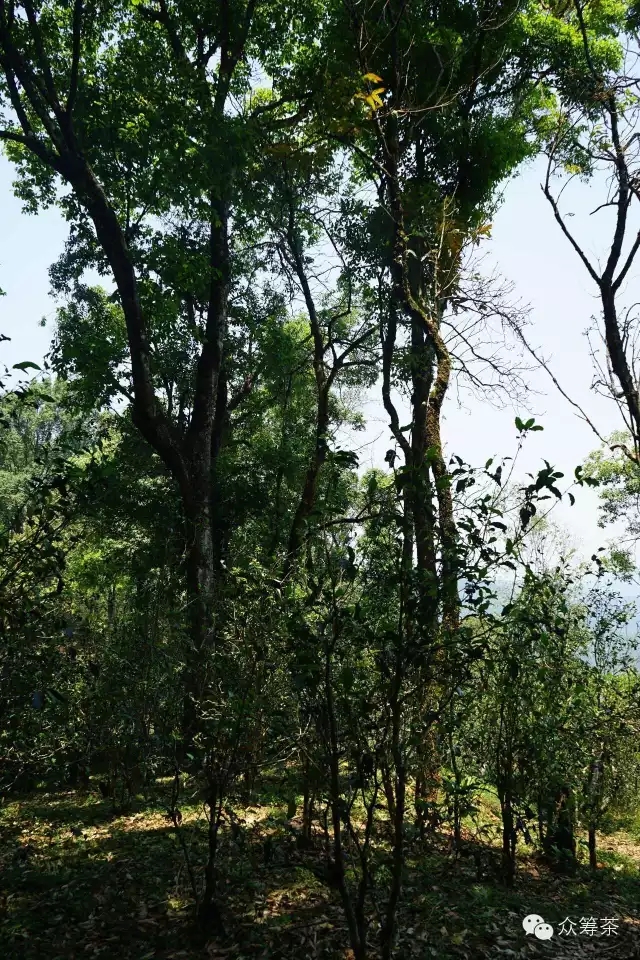
Small tree tea in a forest ecosystem
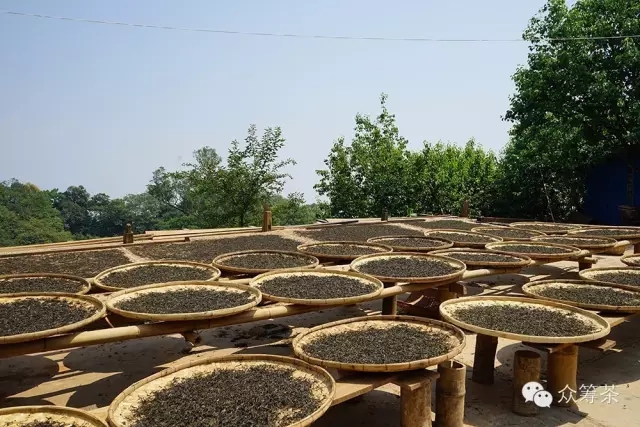
Drying area of the initial processing facility in the forest
What does Alpha version mean?
I previously worked on open-source WEB software. An Alpha version is provided for testing but not recommended for official use. A Beta version is unstable but can be used officially, while the official version is recommended for use. Alpha versions generally do not provide data upgrades; even if used, they cannot be upgraded. Beta versions usually provide data upgrades.
Here, the good tea formula uses the Alpha version, implying that this version is for trial use and has not been tested by the market. It can be used for reference.
There are a few more points to discuss.
- You might think my formula is nonsense.
That's fine. This formula is purely my personal understanding. Of course, I have conducted extensive research, learning, and communication with others. Also, during this attempt to create standard tea samples from the mountains, I did many comparative tastings of large and small trees. This formula is an interpretation of my current understanding of tea. Explaining this formula and clarifying it is my business. If you don't understand and think it's nonsense, that is entirely your own business. I'll speak it, and you can listen as you wish.
- The issue of score proportions.
Similarly, this is my understanding. You can adjust the coefficients according to your own understanding and apply this formula.
- According to this formula, some teas have similar scores, but why do their prices differ greatly?
Indeed, for good tea, it might be only slightly better, but the price difference is huge. For high-end good tea, it is better by a little but costs much more. Isn't that the case with many things in our lives?
- Not targeting anyone.
I am not targeting anyone, really, whether you believe it or not. I have been in the tea industry for 8 years. Before, I sold a lot of tea in a muddled way. Fortunately, during the process of selling tea, I had the honor to meet several teachers such as Huang Chuanfang, Liang Xiangtian, and Huang Xiaoyuan, and only then did I start to deeply engage with and understand tea. Today, this formula is just my own understanding. If you want to scold someone, scold me; please don't scold the teachers. I do not own any tea fields, nor have I contracted any tea trees. I derived this formula entirely based on my own understanding, without any conflicts of interest, so it seems fairer.
The article and images are original. Author: Lü Jianfeng, WeChat: ynwuse, working at 51 Pu'er Net, initiator of the Houyue Crowdfunding Tea.
Comentarios por párrafo 0 · moderado
Comentarios 0 · moderado