
Recently, the Yunnan Tea Industry Association issued an official document with eight suggestions for the tea industry in Yunnan (see image below). It stirred up a hornet's nest, and the main point of contention is that the document states 'Pu-erh raw tea is sun-dried green tea.' What does sun-dried green tea mean? It means green tea, just sun-dried. So the debate is whether Pu-erh raw tea belongs to green tea. Once these eight suggestions were put forward, some agreed, some cursed, and some openly opposed. I am one of the open opponents, but since I am of little importance, not many people pay attention. Still, some privately ask me why I say Pu-erh raw tea is not sun-dried green tea. This year, my energy is mainly focused on Houyuehong company matters, and I haven't written in the 'Tea Talks on Paper' series for a long time. I haven't calmed down to explain the reasons before. Today, let me slowly discuss it from the perspectives of emotion, reason, law, industry, and future.
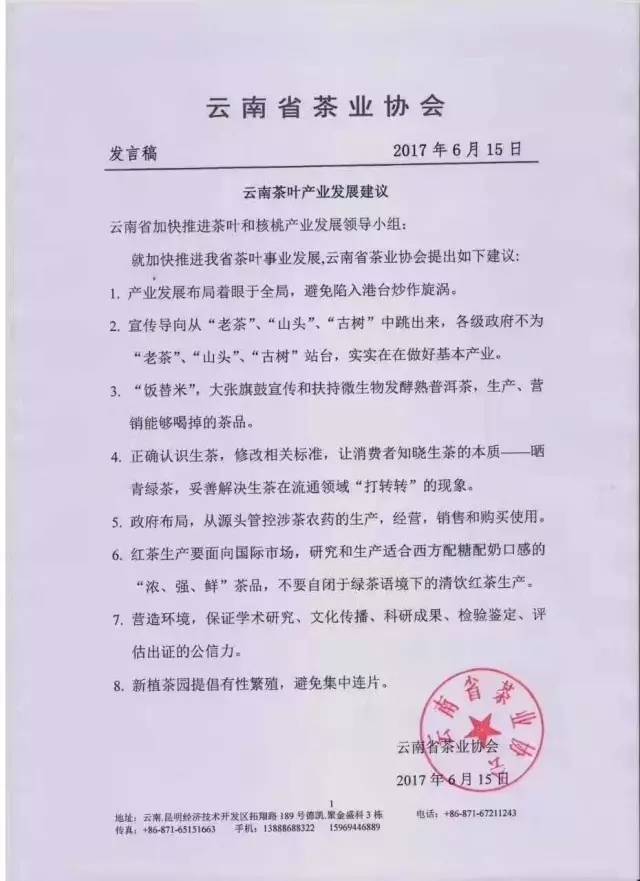
Suggestions for the Development of Yunnan Tea Industry
1. From an emotional perspective, raw tea cannot be sun-dried green tea.
In the Southern Song Dynasty, Li Shi wrote in Xu Bowuzhi: 'The use of Pu tea by the Western Regions (Tibet) dates back to the Tang Dynasty.'
This is the earliest recorded history of Pu tea, but we know that Pu'er Prefecture was only established in the Qing Dynasty, so could this 'Pu tea' refer to another meaning? In Buddhism, 'Pu tea' means everyone coming together to drink tea, so it might mean 'The Western Regions drank Buddhist tea since the Tang Dynasty.' I think it's not very reliable to consider this as the earliest verifiable time for Pu'er tea.
In 1381, the 14th year of Hongwu in the Ming Dynasty, Pu'er first clearly appeared in official documents. At that time, the Pu'er area was under the jurisdiction of Cheli Xuanwei Division of Yuanjiang Military and Civilian Prefecture, called 'Pu'er' (普耳).
In 1578, Li Shizhen of the Ming Dynasty wrote in Compendium of Materia Medica: 'Pu'er tea comes from Pu'er, Yunnan.'
In 1620, Xie Zhaozhi recorded in Dianlue: 'Both officials and commoners use Pu tea. It is steamed and formed into cakes.'
We can see that Pu'er tea has a history of over 600 years from 1381 to 2017. But is this 600-year history the history of raw tea, ripe tea, or neither raw nor ripe but something else?
Manshu records: 'Tea comes from the mountains around Yinsheng City. It is harvested loosely without specific methods. The Mengshe barbarians cook it with pepper, ginger, and cinnamon to drink.' This is definitely neither ripe nor raw tea.
In the Qing Dynasty, Zhao Xuemin's Supplement to Compendium of Materia Medica says: 'Pu'er tea tastes bitter and has a harsh nature. It can remove greasy from beef and mutton, is bitter and astringent, resolves phlegm, and promotes bowel movement.'
'Bitter and harsh' – ancient writers liked neatness, so 'taste' pairs with 'nature', 'bitter' with 'harsh', roughly meaning the tea is bitter and strong, not mild. I believe the Pu'er tea mentioned in Supplement to Compendium of Materia Medica refers to today's raw tea.
Ripe tea is a concept that only appeared after the successful trial production of artificial pile fermentation in 1975, just over 40 years ago. Only after ripe tea existed did the concept of raw tea emerge. But as previously stated, the 600-year history of Pu'er tea refers to today's raw tea. The term 'raw tea' is recent, but its history is long. A 40-year-old concept (ripe tea) wants to monopolize the term Pu'er tea (though they consider raw tea over ten years old as Pu'er), while a 600-year history wants to exclude raw tea from Pu'er and classify it as green tea...
Isn't this like a cuckoo taking over a magpie's nest? Emotionally, I think this is very inappropriate, extremely inappropriate.
Let me clarify: I have no intention of belittling ripe tea. On the contrary, this year we are vigorously promoting the second crowdfunded ripe tea of Houyue. But that doesn't affect my firm stance that raw tea is Pu'er tea. The Yunnan tea industry should advance on both raw and ripe legs, which is something other tea industries dream of. We must not destroy our own Great Wall and shame future generations.
2. From a rational perspective, raw tea cannot be sun-dried green tea.
Let's make an assumption. We know Wuyi Mountain is the birthplace of black tea. Zhengshan Xiaozhong is the ancestor of black tea, and Jinjunmei is a new tea of the last decade but famous nationwide. Let's assume a tea association in Fujian proposes the following:
To better develop Wuyi black tea and vigorously promote Jinjunmei, considering that Zhengshan Xiaozhong has a high-temperature pan-firing process (red pan), we suggest classifying Zhengshan Xiaozhong as roasted green tea. Jinjunmei is the real Wuyi black tea, and non-bud Jinjunmei is called Chigan.
I believe the moment this suggestion is announced, it will be the clarion call for everyone to condemn the association. People will attack it, and the Fujian government will immediately refute it as nonsense.
Isn't today's 'raw tea is sun-dried green tea' similar to this assumption? Why doesn't the Pu'er tea industry universally condemn it? I think there are several reasons, which I'll list briefly without deep analysis.
- The official document of the Yunnan Tea Industry Association has semi-official authority.
- Led by tea industry bigwigs, there is a certain high-ground advantage. Recently, a bigwig's social media post caused trouble for Green Snow Bud. Actually, when I visited Fuding and learned about Green Snow Bud, they do have aged white tea and a systematic approach. But I'm not a party involved, so I don't know the details and won't comment.
- Chinese moral inertia: 'Sit quietly and reflect on your own faults; in conversation, don't discuss others' wrongs.' Those who think it's wrong are unwilling to speak; those who think it doesn't matter or is right won't speak.
- There is some truth to it. The statement 'raw tea is sun-dried green tea' has some validity, and many practitioners feel the same.
- If you oppose, you are considered to be looking after your own interests. The bigwig said, 'The reason Pu'er tea has so many controversies is that the industry is dominated by culture, and many mix in personal interests...' If you oppose, it's because you have stored a lot of new raw tea and have vested interests. Indeed, many practitioners store raw tea. Once you're labeled, how can you oppose?
- Many agree. Their voices are loud, with interviews, videos, and even quotes. Those who want to oppose see their acquaintances and friends agreeing, so how can they oppose?
- There may be many other reasons; welcome to add.
But many seemingly respectable people and things are not necessarily right.
Let's present some facts.
First, look at the national standard for green tea GB/T 14456.1-2008:
Using the buds, leaves, and tender stems of the tea plant (Camellia sinensis L.O.kunts) as raw material, processed through fixing, rolling, drying, etc... Green tea products are divided into pan-fired green tea, baked green tea, steamed green tea, and sun-dried green tea according to different processing techniques...
It can be seen that sun-dried green tea also conforms to the national standard for green tea.
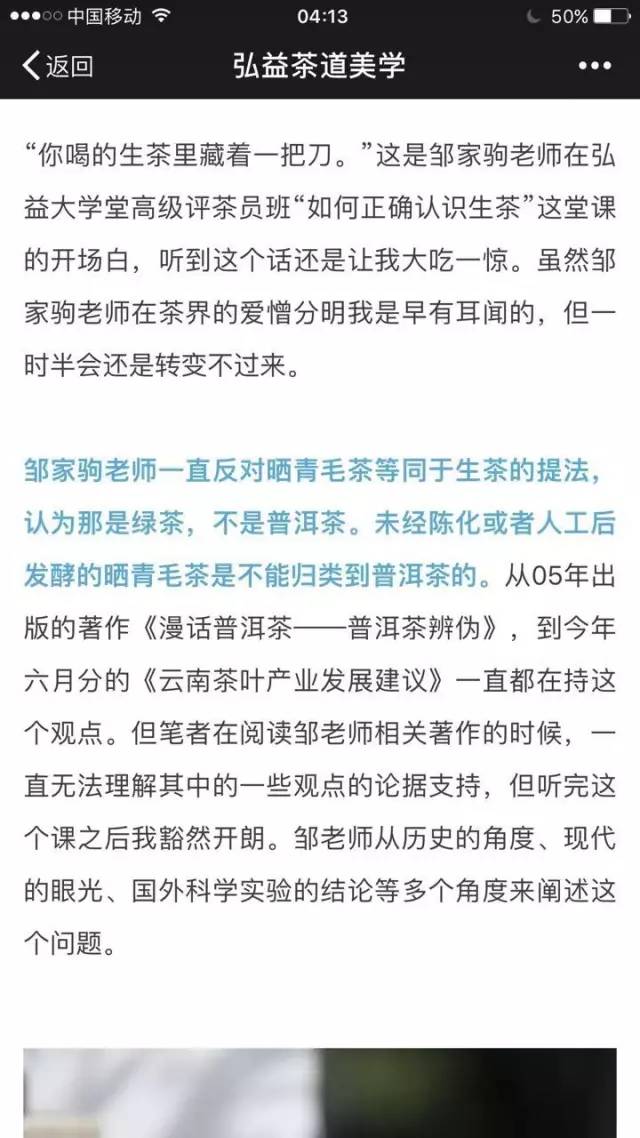
But go to Yiwu and see: single-tree, high-stem, ancient tree teas are mostly made as raw tea. Innkeepers, hotels, and tea shops all have practitioners tasting tea, often all night until dawn. They come every year, drink new tea every day. This contradicts one of the important reasons for 'raw tea is sun-dried green tea' – that new raw tea cannot be drunk. Some Yiwu raw teas even have five or six leaves per bud. Look at other tea regions: it's common for raw tea to be picked quite old. This clearly conflicts with the green tea national standard. Are we going to revise the green tea national standard?
Mr. Zou Jiaju, president of the Yunnan Tea Industry Association, holds the view of 'one knife'.
We know green tea is meant to be drunk in the same year. Our association wants to classify raw tea that is not suitable for drinking in the current year, or even within ten years, as green tea. Green tea doesn't want to take this blame; green tea is drunk fresh. What's the point of making a raw tea that can't be drunk fresh? Are we going to add new categories like 'raw green tea' or 'green raw tea', turning six tea categories into seven? Mr. Chen Chuan, what's your opinion?
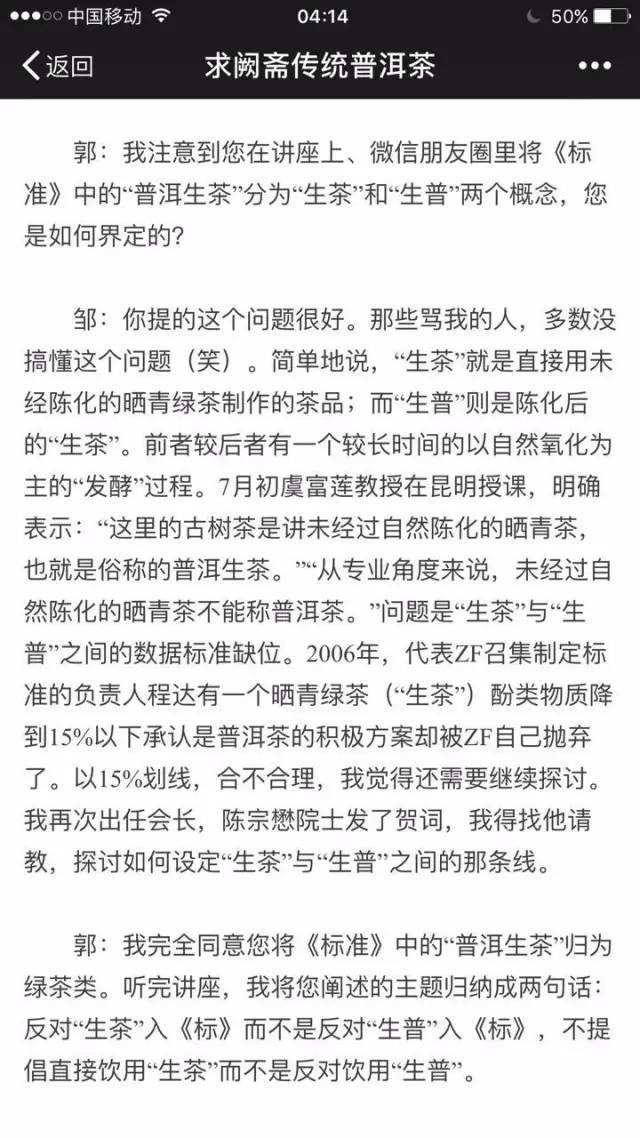
The president of the Yunnan Tea Industry Association believes raw tea should be classified as green tea.
Let's also look at the storage of raw tea. Loose raw tea is usually stored in woven bags for a while to let off moisture, which is completely different from green tea that needs sealed storage. Compressed raw tea is wrapped in bamboo shoots or paper bags, not sealed, and can be stored for years or even longer. Green tea can't do that.
The most important point is that the advantage of origin cannot be lost.
Moutai liquor is produced exclusively in Maotai Town, Renhuai City, Zunyi City, Guizhou Province, China. It is a traditional specialty liquor. If you make a liquor with similar Moutai process elsewhere, is it Moutai?
According to law, only sparkling wine produced in the Champagne region of France, using specified grape varieties and specified production methods, can be labeled as Champagne. Outside the Champagne region, even if you make a better-tasting sparkling wine, it's just sparkling wine and cannot be called Champagne.
Longjing is a famous historical tea with strict regional regulations; only the West Lake production area can be called Longjing. It's easy to learn Longjing techniques, but you can't make Longjing tea outside the Longjing production area. If the name is not right, consumers may not accept it, and legal risks are imminent.
This is the advantage of origin!
If you abandon the origin advantage of Pu'er tea, its culture, and long history, and only talk about processing techniques, you haven't truly understood Pu'er tea, or you simply don't understand it. Non-Yunnan teas made with Pu'er techniques can only be sold as Pu'er through counterfeiting. If you ignore the huge origin and historical culture advantages and only talk about techniques, isn't that like climbing a tree to catch fish? Does such a viewpoint make sense? I tell you the phoenix only perches on parasol trees, only eats bamboo seeds, only drinks sweet spring water. You interrupt and ask: Is phoenix meat delicious? Seriously wounded. Blind men touching an elephant will always have partial understanding. Are we sure we want to do this?
Of course not! Absolutely not!
So, rationally, raw tea is completely not green tea.
3. From a legal perspective, raw tea cannot be sun-dried green tea.
The national standard for geographical indication product Pu'er tea GB/T2111-2008 clearly stipulates that Pu'er tea includes Pu'er tea (raw tea) and Pu'er tea (ripe tea).
Among them, the raw tea standard specifies: Yunnan large-leaf sun-dried green tea
Yunnan large-leaf tea fresh leaves are processed through: spreading → fixing → rolling → deblocking → sun drying, etc.
Fresh leaf spreading: Spread fresh leaves in grades until water content is about 70% before fixing.
Fixing: Fix thoroughly and evenly, without grassy or smoky smell.
After fixing, roll promptly into strips.
Rolling: Pressure should not be too heavy, time 30-40 minutes.
Deblocking: Dissolve clumped tea.
Sun drying: Must be sun-dried, during which it can be rolled once more to tighten the strips. Sun-dried tea water content ≤10%.
Legally, it's easy to understand: the national standard has clear provisions and should be followed. Legally, sun-dried tea cannot be green tea.
If you have opinions or new views on the national standard, you can communicate through appropriate channels and apply for amendments. As an association, you should not publish opinions that contradict the national standard to society. You should apply through normal channels and keep it confidential. Publicly stating a viewpoint that contradicts the existing national standard, even stamping it with an official seal and spreading it, is like forcing the issue and may even be illegal.
4. From the industry's current situation and future development, raw tea cannot be sun-dried green tea.
It should be said that today's Pu'er tea situation is hard-won. Raw Pu'er and ripe Pu'er have become two pillars supporting the development of the Pu'er tea industry. The Pu'er tea industry, walking on both raw and ripe legs, is still staggering and struggling. I also think the Pu'er tea industry has its dangers.
But we should see that raw tea, especially high-end ancient tree raw tea, has made great contributions to the promotion and output of Pu'er tea. In my 'Tea Talks on Paper No. 2: The Temptation of Tree Age 1', I mentioned that Pu'er tea benefits from two keywords: 'more fragrant with age' and 'ancient tree tea'. The former is mainly credited to Mr. Deng Shihai from Taiwan, and the latter to the efforts of many practitioners. But ironically, the 'Eight Suggestions' deny both contributors. It's not impossible to hide the bow and cook the hound once the birds are gone, but before a new industry hotspot is stabilized, these two contributors are still the strongest driving forces. We must resolutely not destroy our own Great Wall or do things that grieve friends and gladden enemies.
Will the Pu'er tea industry develop better without raw tea?
I firmly oppose. Two reasons:
1. Consumers have to relearn.
Pu'er tea includes ripe tea and raw tea over ten years old; raw tea within ten years is sun-dried green tea... The banner of Pu'er tea, which was hard to raise, is being torn in half. Practitioners understand easily, but consumers are absolutely confused. Can't they just not drink it? The learning cost for consumers is too high. The day 'raw tea is green tea' is confirmed may be the beginning of Pu'er tea's nightmare.
2. The foundation of ripe tea is built on raw tea.
It's like a building: the foundation is raw tea, and the above-ground structure is ripe tea. If you say the foundation is not good and is something else, and only after ten years can it be considered the foundation, can you live in that house with peace of mind? Raw tea is the foundation. If the foundation is not Pu'er tea but green tea, how can Yunnan compressed tea become more fragrant with age? If ripe tea, which is fermented from green tea, is the only Pu'er tea, what kind of logic is that? It's simply absurd!
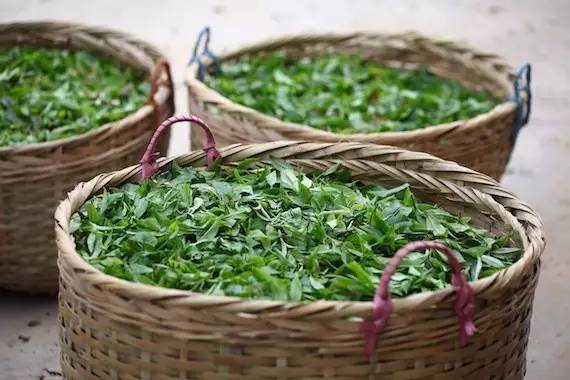
Yunnan large-leaf tea leaves
5. For the future, where will raw tea go?
Many times, people worry unnecessarily. Raw tea has a history of several hundred years, and it has been in the market economy for over twenty years. After the 2007 Pu'er tea crash, it has recovered and become stronger. Besides 'more fragrant with age', there is also the concept of 'ancient tree tea'. It should be said that this year's Pu'er tea industry, including raw tea, is relatively healthy. Of course, everything has multiple facets, and it's normal to have various problems during development. We should look at problems with a developmental perspective. If you nitpick and magnify anything, you can always find a lot of problems. Calm down and imagine: in the next hundred or even several hundred years, what will Pu'er tea look like, and what should it look like? Doing things in the trend channel is the best strategy.
I believe raw Pu'er tea will develop in the following directions:
1. Sweet, fragrant, mild, and immediately drinkable raw tea will be a major market trend.
Tea that is drunk is the real deal. Raw tea that is cold, harsh, and thin is indeed hard for many to drink. Sweet, soft, fragrant, and moist raw teas are already many in the market. Their later transformation remains to be seen, but there's no reason to reject tea that can be drunk now. Such tea soup may not be red; raw tea with a mild and soft taste, delicate aroma, and bright yellow soup will be a beautiful sight in the market.
2. 'Bitter and harsh' raw tea will still exist, stored for ten years or more to enjoy the 'more fragrant with age' later.
The charm of aged raw tea is indeed fascinating. The main problem with raw tea today is the huge quantity and uneven quality. Have you ever seen high-quality, well-priced, delicious aged raw tea that can't be sold? If so, send it to me to taste; maybe I'll buy some for you. The storage of raw tea will certainly not disappear; it will just adapt to the market, with more attention to quality and storage control.
3. Small packaging and convenient packaging will also become mainstream.
Raw tea's taste is easy to get used to, and packaging forms will become more diverse. Convenient small packages of raw tea will definitely become popular. Whether compressed or loose, what matters is good taste and convenience.
4. Niche concepts will be everywhere.
Reprocessed raw tea forms like small green citrus, lemon, tea paste have already appeared. Roasted raw tea, high-aroma raw tea, even burnt-aroma raw tea may appear. Blended raw tea drinks like black tea are also possible. Various fancy raw teas will increase. Many unknown raw tea blends will emerge in large numbers. The richness of raw tea products will make the raw tea market more segmented. Currently, everyone makes the same products, selling bricks, cakes, tuos, and loose tea; that will be the main model for large factories.
5. More niche brands will appear, and a large number of family century-old time-honored brands will emerge.
Tea farmers selling tea will become more common. Today's Wuyi Mountain will be Yunnan's tomorrow. There will be more and more niche brands. Handmade tea will become mainstream in tea mountains. Future tea masters will mostly be today's tea farmers or their second or third generation. High-quality, high-priced tea will be the business model of these niche brands. Coarse, cheap tea will become increasingly rare in tea regions.
There may be many more changes, but no matter what, one thing is certain: the future of raw tea will be better and better!
6. Conclusion
The reason why 'raw tea is sun-dried green tea' has caused such a big discussion is that the Pu'er tea industry definitely has its problems. But everything is multifaceted; there is no absolute right or wrong. It's not that if I don't agree with you, I oppose you. It's not that promoting aged tea or ripe tea today means smearing raw tea. The problems with raw tea lie in process guidance, storage improvement, and market control. Arbitrarily abandoning new raw tea and pushing it into the green tea camp is putting the cart before the horse. It is not the proper attitude to solve problems, nor is it a solution.
On a large scale, there is government management, policy support, and industry organization guidance. On a small scale, practitioners like us should honestly make good tea, not participate in speculation or malicious price manipulation, and do our duty. I think that might be better.
Finally, let's do a survey. You can give your own opinion: Is raw tea sun-dried green tea? (You can leave a comment below to discuss.)
The article is original; some images are screenshots from the internet, and I thank them all. Author: Lü Jianfeng, WeChat: ynwuse, working at 51 Pu-erh Net, initiator of Houyue crowdfunded tea, convener of Yunnan Houyue Black Tea Co., Ltd.
Comentarios por párrafo 0 · moderado
Comentarios 0 · moderado