
I have two years of history in making black tea. Last year's Houyue crowdfunded ancient tree sun-dried black tea was not made by hand, but I participated in designing and finalizing the process; this year, the black tea primary processing factory invested by my shareholding crowdfunded black tea company was built entirely by me, from land leasing, factory renovation, equipment, trial production, stable production, to the upcoming second Houyue crowdfunded ancient tree black tea and Houyue series tea products, all of which I personally did or participated in; this year we made a total of thirty tons of sun-dried black tea and three tons of oven-dried black tea. I should say I have some say in understanding Yunnan black tea. I think some market perceptions are incorrect. This article organizes some of these; if there are errors, I hope you will point them out, and I will definitely improve. You can leave a comment or add my WeChat 673998. Thank you!
The title of the article is: "Lies" about Yunnan black tea. Yunnan black tea, as a world-famous tea, does not lie; it is people who lie, intentionally or unintentionally. Due to market promotion needs, misleading by others, and insufficient understanding, some incorrect statements (which I mark as "lies" in quotes) are inevitable, and other industries are the same. Clarifying is for better development. Including this article, with deeper scientific research and process improvements, it may also become a lie in the future; these are all possible. As long as we follow our inner thoughts, as long as our current understanding is like this, it has positive significance.
Okay, let's get down to business. Let's go one by one in numerical order.
1. All Yunnan black tea has a sweet potato aroma.
Wrong. Only high-temperature baked Yunnan black tea will have a sweet potato aroma. According to my experiments, temperatures above 100 degrees Celsius, insufficient moisture in the tea itself, and sufficient time will produce a sweet potato aroma. Most sun-dried black tea on the market, including our sun-dried black tea, hardly has a sweet potato aroma.
Some might say, "You are citing examples of sun-dried black tea; oven-dried Yunnan black tea all has a sweet potato aroma."
Also wrong. Oven-dried Yunnan black tea (hereinafter referred to as "oven-dried black tea") can be completely free of sweet potato aroma and can have floral and fruity aromas. If you don't believe it, try our Houyue numbered 900 oven-dried black tea.
2. Floral aroma is added.
Wrong. Floral aroma, or fruity aroma, if the fresh leaves have no obvious problems such as pesticide residues or damage from long transportation, through normal black tea processing, with absolutely no additives, the charming floral and fruity aroma naturally occurs. Regarding this, you can drink other places' Wuyi Mountain Zhengshan Xiaozhong, Keemun black tea, and sun-dried black tea from Yunnan tea areas with normal processing, including our first Houyue crowdfunded sun-dried black tea.
3. Black tea is fully fermented tea.
This sentence is often said as: green tea is zero-fermented tea, black tea is fully fermented tea, and oolong tea is semi-fermented tea. I think this statement is very inaccurate. Fresh leaves begin to ferment as soon as they are picked from the tea tree. Strictly speaking, according to the current processing of various tea categories, there is no zero-fermented tea.
Take Longjing as an example of green tea. Let's look at the national standard for Longjing regarding processing:
4.6 Processing
4.6.1 Processing equipment: traditional wok-frying stove, electric wok-frying stove, or other processing machinery.
4.6.2 Processing technology: fresh leaf spreading, green pan firing, spreading and cooling, and final drying.
4.6.3 Processing techniques: manual processing uses traditional methods such as "grasping, shaking, pressing, spreading, pressing, pushing, hooking, flinging, grinding, pressing."
The national standard for Longjing clearly stipulates that the process includes fresh leaf spreading. According to my understanding of Longjing production, many also have a sun-drying fresh leaves step. Longjing fresh leaves are typically spread to lose about 20% moisture. Based on my experience, losing 20% moisture under natural room temperature conditions takes about 4-8 hours. During these hours of spreading, fermentation is inevitable, and fermentation is even to a certain extent.
Take sun-dried black tea as an example. Many sun-dried black teas have a greenish and off-flavor when brewed and tasted, which is the result of insufficient fermentation.
Take oven-dried black tea as an example. Old black tea becomes more mellow over time, and many tea lovers enjoy drinking old black tea. Can you say these black teas are 100% fermented? If 100% fermented, there would be no room for later transformation, and the other result would only be deterioration.
From the fermentation process of black tea, it is easy to understand why 100% fermentation is impossible. Black tea fermentation is always piled in small heaps, commonly weighing more than 5 kilograms, with a thickness of about 10 cm or more. During fermentation, even if turning the pile, it is impossible to achieve complete uniformity. The parts that ferment faster reach sufficient fermentation and need to be taken out for drying; otherwise, they will have a rotten feel. At this time, the parts with lighter fermentation are actually under-fermented.
(Image: Black tea fermentation pile (not finished))
So black tea cannot be 100% fermented.
I think this sentence can be modified to: Green tea is lightly fermented tea, black tea is heavily fermented tea, and oolong tea is medium fermented tea.
4. The yellow-bright liquor color of Yunnan black tea is because it is made from ancient tree tea.
Wrong. The yellow-bright liquor color of black tea is because it was not processed properly, and it has nothing to do with whether it is ancient tree tea. Black tea should have the characteristics of red liquor and red leaves (bottom).
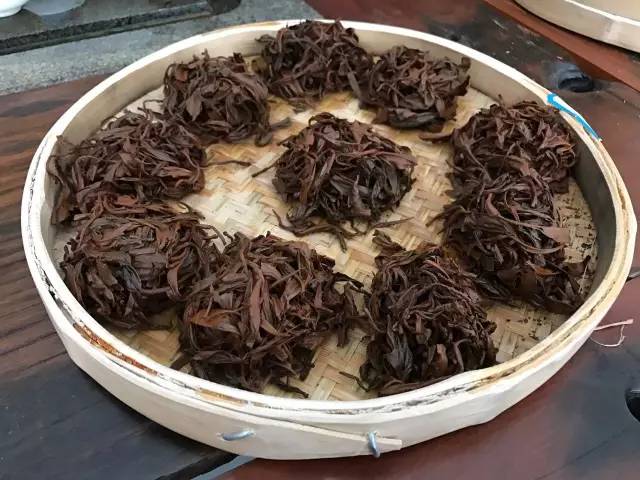
Black tea leaf bottom
5. Look at how thick and bold these strips are; it is ancient tree black tea.
Wrong. The thickness of the strips is greatly related to the processing, and not much related to whether it is ancient tree tea.
Of course, if the same processing is used, ancient tree tea is generally picked older, and the fresh leaves of ancient tree tea are slightly thicker, so the resulting strips will appear thicker. But most market perceptions about ancient tree black tea strips are to mislead consumers, to pass off inferior as superior.
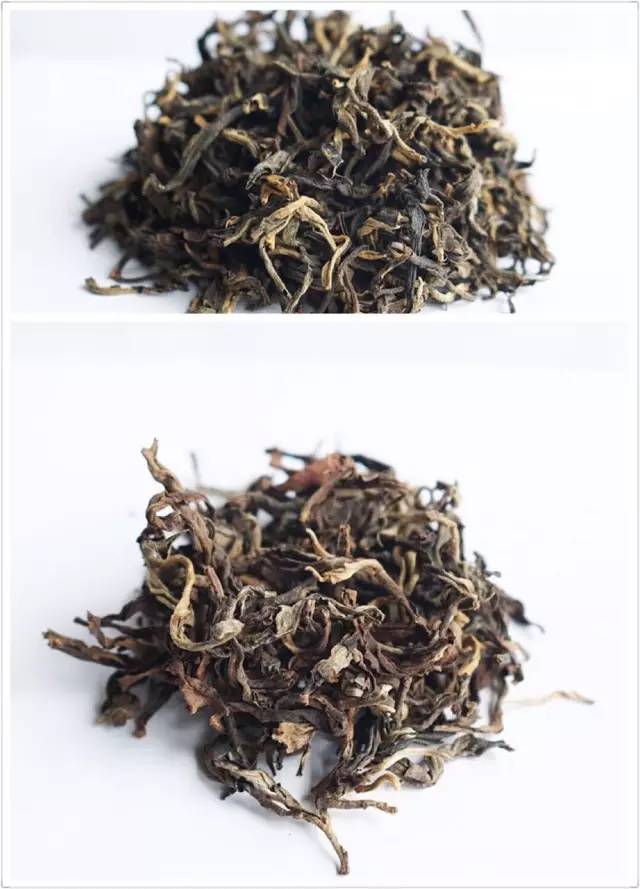
Comparison of black tea strips
Take the above image as an example. Isn't the black tea below thicker in strips, and the one above finer? Actually, the one above is ancient tree tea, and the one below is not. During black tea processing, according to the quality of fresh leaves, it is necessary to adjust the degree of withering and the tightness of rolling. If rolling is pressed tightly, the strips will naturally appear finer; if rolling is not pressed, the strips will appear thicker.
Today I read a WeChat public account article saying that loose strips and tight strips only relate to the speed of infusion, and everything else is to fool people. Actually, that is not the case, indicating that the author has not actually entered the production environment and does not truly understand the uses of loose strips and tight strips. I will give two examples. Raw tea used for fermenting ripe tea needs to be made into tight strips, partly because fermentation quality is better, but the most important reason is to reduce fermentation loss. Making tight strips results in much less broken pieces in the ripe tea after fermentation. Also, when making black tea, if pressing rolling causes breakage (related to season and withering degree), we will choose to make loose strips.
Therefore, the statement that thick strips indicate ancient tree black tea is wrong.
6. The redder the liquor color of Yunnan black tea, the better.
Wrong. Combining with the above issue, let's talk about the formation of black tea liquor color.
The liquor color of black tea is mainly composed of theaflavins, thearubigins, and theabrownins. Theaflavins, thearubigins, and theabrownins are different stages of polyphenol transformation, and the different proportions of these three substances determine the liquor color and quality of black tea.
Thearubigins are the most abundant class of substances in black tea oxidation products, with a content of about 6%–15% in black tea. Thearubigins are soluble in water, and their aqueous solution is deep red, with weaker stimulation and a sweet and mellow taste. They play a very important role in the taste and concentration of the liquor. Because of the presence of thearubigins, black tea liquor is "red."
The content of thearubigins is not the higher the better; if too high, it harms quality, making the taste weak and the liquor color dark.
Theabrownins are mainly formed by oxidative polymerization of theaflavins and thearubigins. Theabrownins have the largest molecular weight and are the most stable. They are another reason for the "red" liquor color. When the content of theabrownins reaches 6%–8%, the liquor color can show a red-brown and bright quality characteristic. High content of theabrownins is detrimental to black tea quality; the higher the content, the darker the liquor and the darker the infused leaves.
Therefore, the liquor color of black tea is not the redder the better, but the best is when the proportions of theaflavins, thearubigins, and theabrownins are coordinated. Black tea quality requires not only that the liquor color be "red" but also "bright," and under natural light, the surface where the liquor contacts the cup should have a "golden ring."
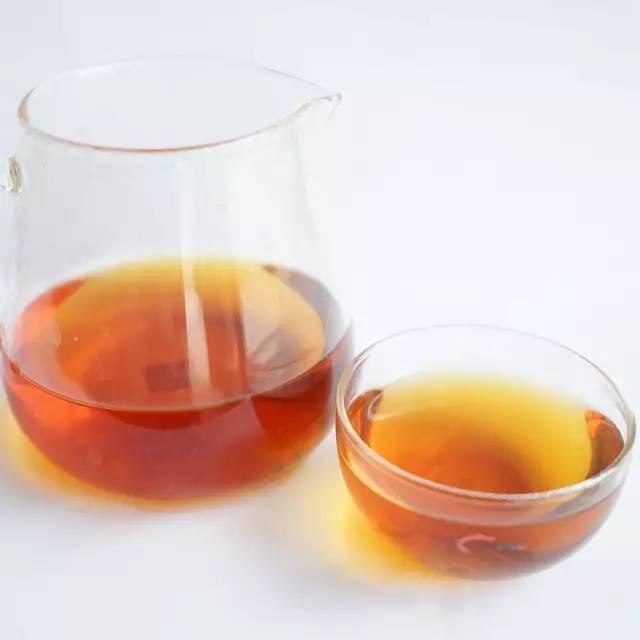
Black tea liquor color
So, the liquor color of black tea is not the redder the better. Similarly, black tea with a wine-red liquor color is not necessarily high-grade black tea.
Both text and images are original! The author of this article is Lü Jianfeng, WeChat: ynwuse, working at 51 Pu'er Net, initiator of Houyue crowdfunded tea, and convener of Yunnan Houyue Black Tea Co., Ltd.
Comentarios por párrafo 0 · moderado
Comentarios 0 · moderado