
Today, let's talk about some stories between tea merchants and tea farmers regarding ancient tree tea.
"See that old lady?" the village head pointed to an old lady sitting by the door, dozing in the sun, and continued, "That old lady said that the ancient tea trees in our village were this big when she was a child, and she doesn't know how many years they've been there. We estimate they must be several hundred years old."
In a village on a famous tea mountain, the village head introduced the age of their ancient tea trees to Mr. Huang, a tea merchant from Guangdong. Later, Mr. Huang became familiar with the village head's son, who was in his twenties. Once, after drinking, the son told Mr. Huang that those ancient tea trees were actually planted by his father (the village head) when he was a child, and they were only about thirty years old.
I have heard multiple versions of such stories, and the narrators often show a hint of helplessness. However, those who love ancient tree tea, driven by both personal preference and business needs, continue to search for ancient tree tea in various parts of Yunnan. More and more tea merchants are going deep into the mountains, such as Guafengzhai and Tongqinghe. These places require riding motorcycles, and when the mountain roads become impassable, they have to walk for another hour to reach the tea fields. They believe that deep in the mountains, where no one has set foot, is natural, that good tea speaks for itself, and that these teas are genuine. Thus, many tea enthusiasts wait at the roadsides, scrambling for fresh leaves, and prices naturally keep rising. It is said that many local farmers would carry a basket of fresh leaves up the mountain, then walk out boldly, and quickly earn tens of thousands of yuan. Of course, this is just hearsay.
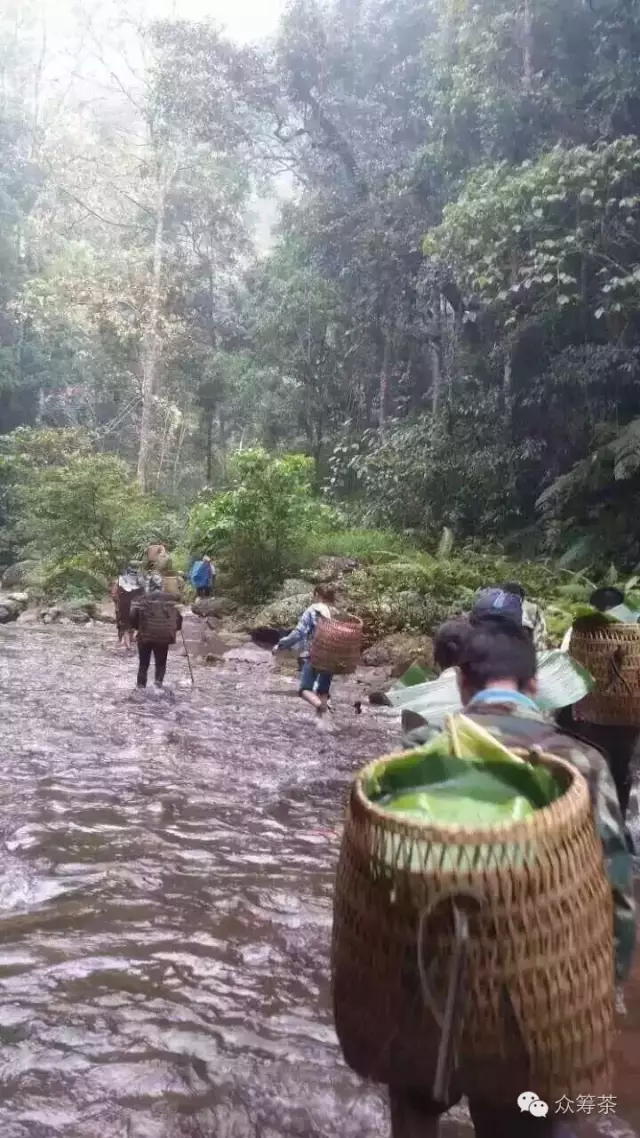
Tea farmers wading upstream to the tea trees (photo saved from Moments earlier; I forgot whose it was, sorry)
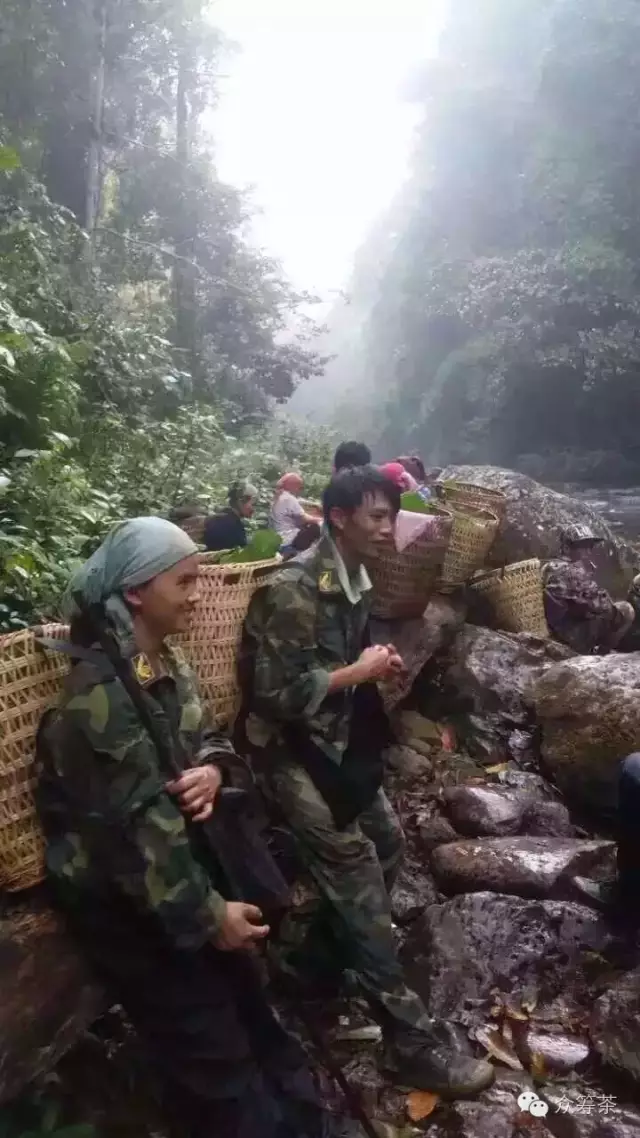
Tea farmers wading upstream to the tea trees (photo saved from Moments earlier; I forgot whose it was, sorry)
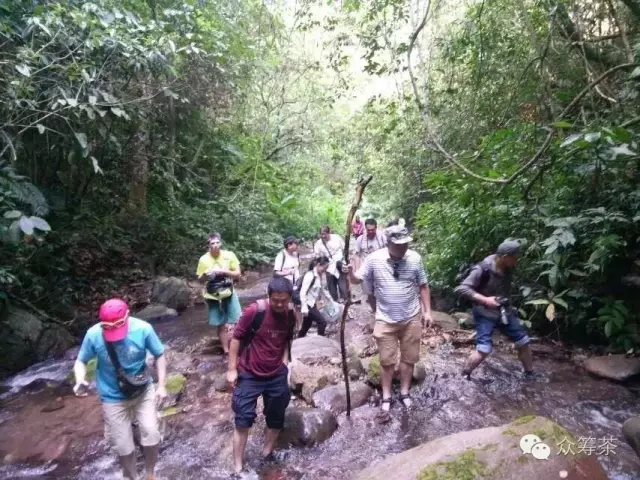
Tea merchants wading upstream to the tea trees (photo saved from Moments earlier; I forgot whose it was, sorry)
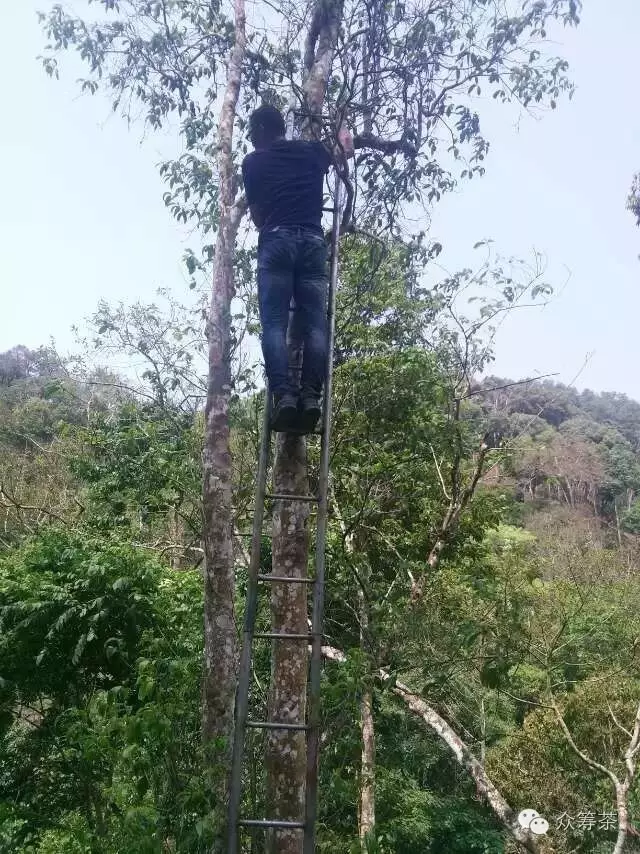
Picking tea from high-stem tea trees (photo saved from Moments earlier; I forgot whose it was, sorry)
There are also many tea farmers who tell the truth. The most common version I hear is this: Many tea farmers say that regarding the age of ancient tea trees, they themselves originally had no idea and didn't know its importance. The previous generation didn't tell them how old these trees were, and they never dreamed that tree age could command such a premium. Initially, everyone sold the tea the same way, mixing it with other small-tree tea. Later, many tea merchants came into the mountains to see the tea trees, specifying that they only wanted to buy leaves from these big trees, telling the farmers that these trees were very old—some over a hundred years, some over three hundred, and even some said a thousand years. Only then did the tea farmers start to care about the age of their trees. At first, they were confused and went along with whatever the merchants said, as long as they bought the tea. Later, as more people came, the farmers gradually began to differentiate. The trees that some merchants thought were big and old started to be sold at higher prices. Eventually, someone would take the lead, and the village head would organize unified pricing. Many tea farmers near water sources could clearly state the age of their trees, and those trees indeed looked large, so they were immediately upgraded to ancient or big tea trees, and sold at the same price as those with unknown ages.
If you go to Lao Ban Zhang this April, you'll see many people guarding under the tea trees, watching the farmers pick, chatting, and directing which trees to pick and which not. Otherwise, they take photos and post them on Moments. I've done that too, guarding with a few friends to pick fresh leaves from ancient trees. Later, we analyzed and discussed for a long time and concluded that there is no better way to ensure pure ancient tree tea. Because next to the ancient trees grow many ecological small trees, and it's natural to casually pick from them. There are even more legends about fresh leaves: some say leaves are hidden on the trees, others say leaves are swapped during withering. Hence, the practice of guarding the picking and taking the fresh leaves away to process themselves emerged—this is the new, time-consuming model of Lao Ban Zhang. Of course, these are just legends and hearsay, not to be taken seriously. We only guarded the fresh leaves and didn't take them away for processing.
Merchants pursue profit, buying high and selling high; tea farmers pursue profit, selling high to support their families; consumers pay higher prices for good things—these are all normal. But the real situation is not entirely like that. Let's hear what other voices say.
Tea farmers say that many people come up the mountain just to take photos and eat. As soon as they arrive, they want to see the big tea trees. Once there, they start taking selfies: standing under the tree, hugging the trunk, climbing the tree, pretending to pick leaves, etc. If there's internet, they post on Moments immediately, saying they've arrived at a famous tea mountain, how big the trees are, and that they've started cooperation. Those who want to appear cultured even compose a poem (author's note: this sounds a bit like me). Then they go back to eat. The hospitable farmers usually slaughter a chicken and prepare wine, and again photos are taken and posted, showing the rustic farm meal. After eating, when the farmer starts to fix the tea leaves (kill-green), phones and cameras are clicking nonstop. Often, someone rolls up their sleeves to stir-fry the tea, mainly for photos to post on Moments. After that, they never return to that mountain or village, nor do they keep in touch. But the farmers often see them posting information about their village's tea, with photos of goods arriving, estimated to be several hundred kilograms. The farmers think they bought from other households, but after asking around, only a dozen or so households, none sold to them. They say they've never seen or heard of such a large order; several hundred kilograms would require multiple households to supply jointly.
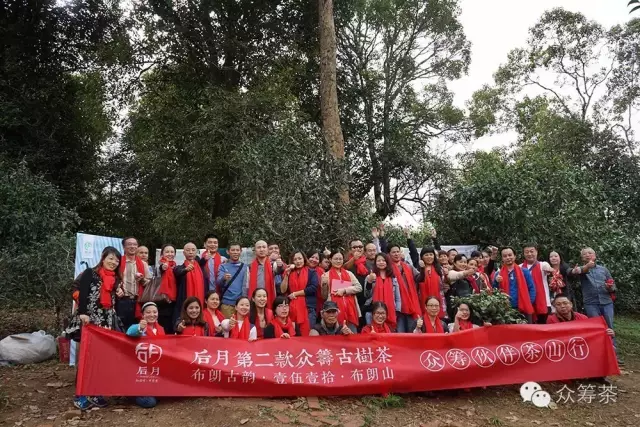
Group photo in front of the Lao Ban Zhang Tea King Tree (Tea mountain tours are already quite popular; our second crowdfunding tea's tea mountain trip included a stop at Lao Ban Zhang)
A tea merchant ordered 200 kilograms of Lao Ban Zhang ancient tree tea this spring, paying half the deposit of 600,000 yuan, insisting on pure ancient tree tea, rejecting mixed picking. Three days later, the farmer called saying it was all done, and to bring the balance to pick up the goods. The merchant went with a few friends to receive the goods. One friend later recounted that the merchant looked at the pile of cartons supposedly containing the Lao Ban Zhang ancient tree tea, asked a few times whether to open the cartons, but ultimately didn't dare to open and inspect, paid the balance, and took the tea away. It's worth noting that at that time, Lao Ban Zhang ancient tree tea had just begun to sprout; even the whole village couldn't have gathered that much ancient tree tea in three days.
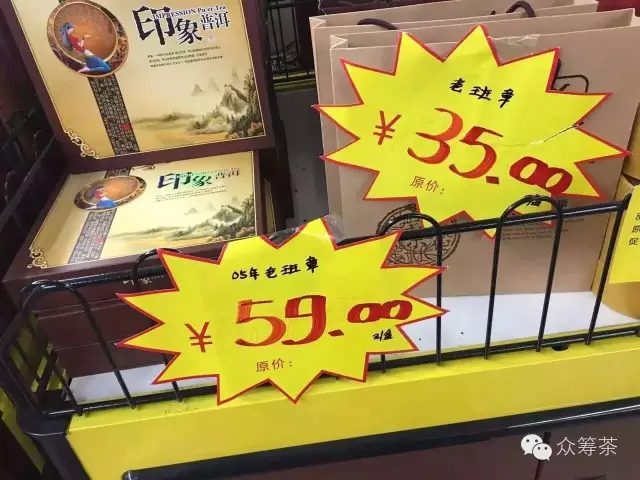
Lao Ban Zhang sold in supermarkets, shared by Xie Fang from Lijiang
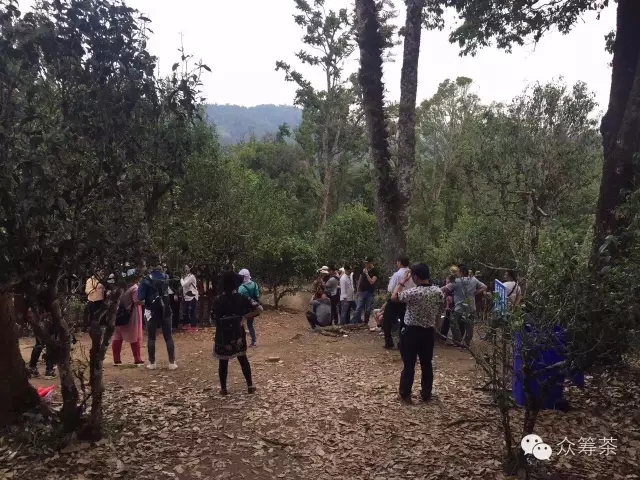
The Lao Ban Zhang Tea King Tree has become a tourist attraction
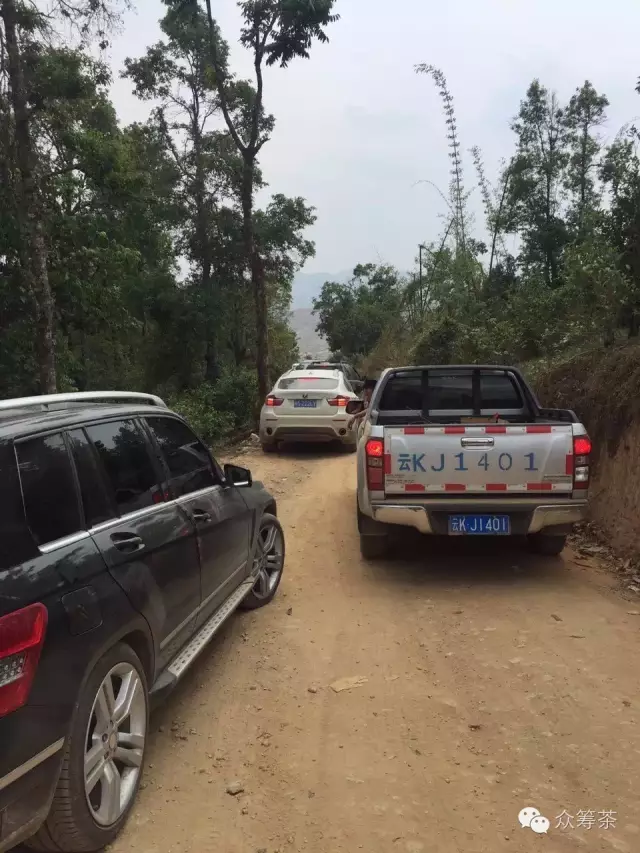
Traffic jam on the road beside the Lao Ban Zhang Tea King Tree
My first time going up an ancient tea mountain was to Jingmai in the spring of 2011. At that time, I heard that the official statistics showed the annual production of pure ancient tree tea from Jingmai Mountain was over 20 tons, but incomplete statistics indicated that the market volume of Jingmai Mountain ancient tree tea exceeded 2,800 tons per year. Now, many small-tree teas from forested areas of Jingmai are also being sold as ancient tree tea. The figure of 20 tons is definitely far exceeded, and I don't have the heart to question this data. The market situation for Jingmai ancient tree tea in 2011 was already this chaotic; now it's only worse.
I often ask people—tea farmers, merchants, scholars—what's so good about ancient tree tea. The most common answer is the following:
Ancient tea trees are large with tall trunks, but their root systems are more developed, penetrating deep into the soil, spreading in all directions, able to absorb many nutrients. The tea soup from such trees has a unique charm. Small-tree tea can never achieve this flavor, just like the chicken from the market can never match the taste of free-range mountain chicken.
I've eaten a lot of chicken and can compare. Indeed, it's true.
Original article, some images from the internet. Author: Lü Jianfeng, WeChat: ynwuse, working at 51 Pu'er Net, initiator of Houyue Crowdfunding Tea.
Comentarios por párrafo 0 · moderado
Comentarios 0 · moderado