
For some reasons, I have been very anxious these years, but I understand tea better and make tea better. Do you know why?
Because of aesthetics, I found the ultimate solution for tea. Aesthetics is not only suitable for tea, but also for wine, aged tangerine peel, and everything that satisfies our palate.
Before 2015, I didn't drink much alcohol, thinking it was the most unnecessary thing in the world, with stimulating taste and physical effects, and it emboldened cowards, making people impulsive and irrational. Later, when I started making tea, I needed to taste a lot of new teas, and my body became damp and cold. Under Teacher Liang's guidance, I learned that aged baijiu (white liquor) can remove dampness and cold, so I developed the habit of drinking. My alcohol tolerance is not high; two liang is my limit. I have been learning to taste wine. There is a wine tasting blogger on Zhihu called A Wu. I bought almost all the baijiu he reviewed, and tried to experience them according to his tasting notes. I spent a lot of time and over a hundred thousand yuan buying wine, but still didn't understand. By 2016, I gave up benchmarking against baijiu and started to use my tea-drinking sensation to experience baijiu, attempting to taste baijiu with body sensation. I understood it in one night; it turned out that wine tasting is so simple. Then I used this sensation to experience aged tangerine peel, rock tea (which I rarely touched), red wine, whiskey, and various dishes. I immediately became proficient and had my own standards. At least within my tasting scope, I established my own standard system and understanding for these things.
Today, I want to share my years of experience with everyone, which is:
The aesthetics of taste!
To understand tea and improve the aesthetics of taste, you no longer need to memorize various complicated parameters: bitterness, astringency, salivation and returning sweetness, fullness, sweetness, thickness, smoothness, balance, calmness, ecology, strong and intense. You don't need to care about these; you only need to feel the taste aesthetics of this tea.
Before talking about aesthetics, let's talk about the wisdom of the ancients.
As mentioned above, I have been very anxious these years. I read a lot of books and watched a lot of videos, many of which are classics of Chinese studies. But due to anxiety, I often had memory confusion, often getting authors, dynasties, characters, and events wrong, but it didn't stop me from continuing. The ten-thousand-hour theory still works. I have realized many things, and one of the most useful points is returning to respect and recognition of traditional culture.
Since childhood, we have been taught to understand science and to live and learn with scientific thinking. Is that wrong? Maybe not, but it is not the only way. There are countless paths to understand the world; science is just one of the main roads. There is a saying: "The end of science is metaphysics." I didn't understand this before, but now I deeply agree. One supporting evidence is that more and more doctors and patients agree that "the end of medicine is traditional Chinese medicine."
Look at the wisdom of our ancients. Some books and phrases that have been passed down for a long time often use just a few lines, or even one sentence, to explain many truths. For example, "One yin and one yang are called the Tao," and "The Tao that can be told is not the eternal Tao; the name that can be named is not the eternal name." Just one sentence, widely spread, and many people deeply agree. If we follow what we learned in school, with arguments, evidence, and proof, isn't it nonsense? How can one sentence have evidence and proof? But this one sentence may be the insight of a person's decades or even lifetime, the summary of these wise men's lives. Isn't a lifetime of proof enough? Westerners mock us for not being rigorous, and we mock them for not understanding romance. Actually, we are equally rigorous; we are rigorous enough to prove with a lifetime, but after saying this sentence, we disdain to expand the proof. If you understand, you understand; if not, you need to realize it yourself. The saying "Art comes from life" also conveys this truth.
What is "realized" is both experience and science. At this point, the nitpickers and some scientific data fanatics can leave.
Today, I will share the taste aesthetics I have realized, in one sentence:
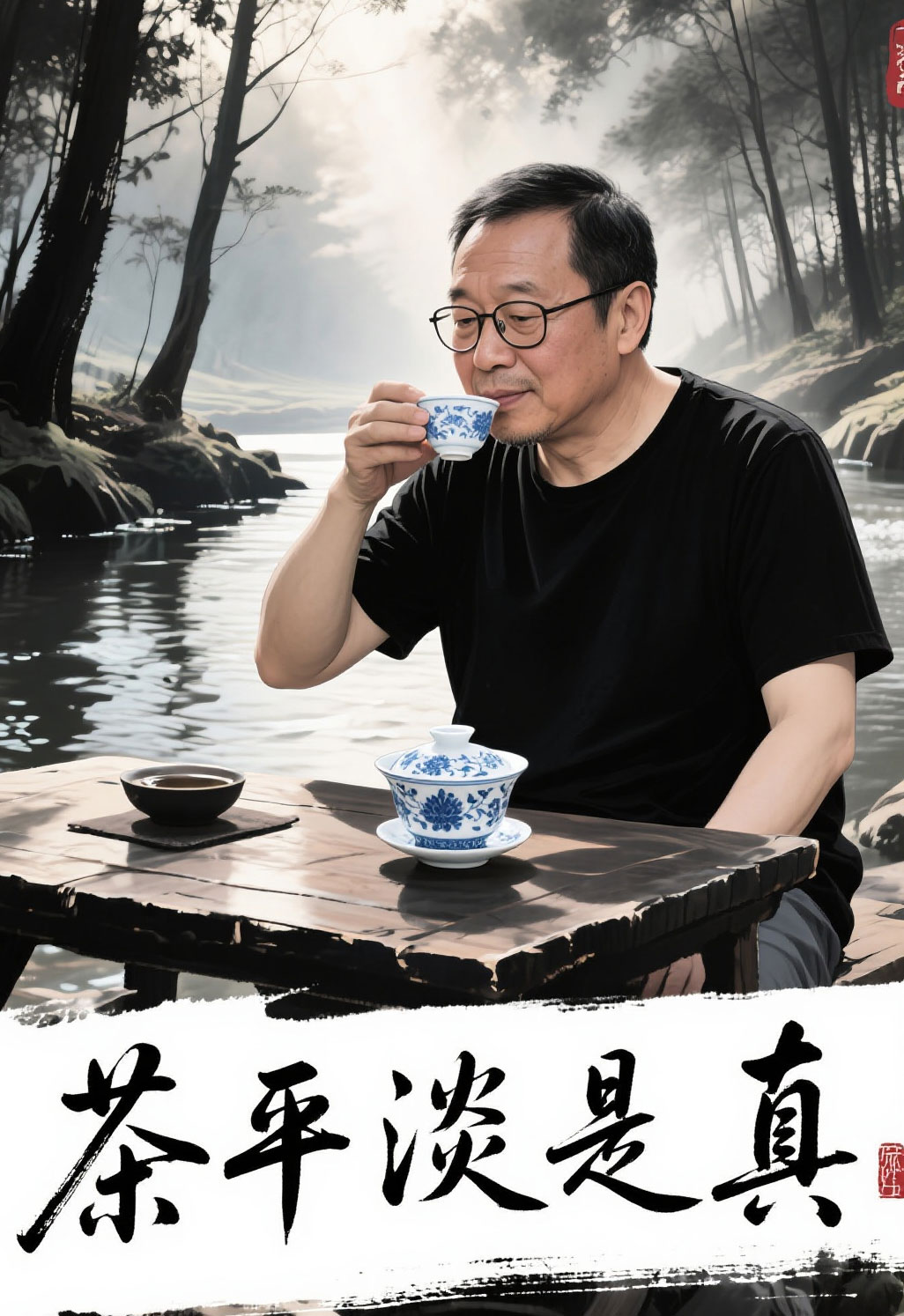
Tea is plain and true!
The ancients said this and left, but I am still here, so let me elaborate.
1. Taste economics.
The more economically developed the region, the lighter the taste. Guangdong, Jiangsu, Zhejiang, Shanghai and other economically developed areas have light tastes, and they mostly eat the original flavor of ingredients.
The better the family conditions, the lighter the taste. Even if they previously had a heavy spicy taste, when their economic status rises, their taste will gradually become lighter. Even if the first generation of the rich has a heavy taste, the second generation will become lighter.
The better the ingredients, the simpler the way to eat them. For example, deep-sea fish is eaten as sashimi, and termite mushrooms are eaten raw. Moreover, these things are also clear and sweet, with a wild charm. Just like free-range chicken can be used for soup, while supermarket chicken needs to be braised or made into spicy chicken.
2. Good ingredients are all clear and sweet.
Such as deep-sea sashimi, mountain termite mushrooms, and tea deep in the dense forest.
In my previous article "What is High-End Tea," I spent a lot of space talking about the calmness of tea. Here I will extend it.
"Bitterness causes salivation, astringency causes returning sweetness" is what many people know. It cannot be said that these teas are not good, but they are definitely not top-grade.
Top-grade tea is consistently clear and sweet, sweet from beginning to end, without needing bitterness or astringency. Those who say "no bitterness, no astringency, no tea" are selling and drinking mid-to-low-end tea. This is also why I have never been fond of Mannuo tea and ordinary Laobanzhang tea, and why I like Yiwu tea and the deep forests of Dehong.
3. Good ingredients are full of wild charm.
Charm is something I always emphasize, and it is also the core element for me to feel other foods that satisfy the palate.
Just like free-range chickens and Donggua pigs, they naturally have a wild charm when eaten, and everyone can feel it. Cold mixed pork belly - if you have the chance to come to the tea area, try it. It is just boiled pork belly, sliced and eaten cold, with a unique flavor.
Good tea and good ingredients all have their own wild charm.
4. Tea is plain and true.
Forget those professional terms, don't attend various tea training sessions, don't listen to the various remarks of masters, don't try to understand tea with effort. Use your body and taste to directly feel the tea, use the sensation of eating. Don't treat tea as tea; treat it as vegetable soup. If it is fresh and you can drink a lot, it is good tea.
Tea is plain and true!
This is the thirty-sixth article in my "Tea Talk on Paper" series. Click to view more "Tea Talk on Paper" articles.
Paragraph comments 0 · moderated
Comments 0 · moderated