
1. Prequel!
In 2017, Houyue crowdfunded a tea, the first generation of fully fermented and fully processed tea, the Crowdfunding Eight Menghai Ancient Rhyme Raw Tea. At the time, I gave this tea to many peers to drink, and most commented that it was "ruined, Pu'er is not made this way," with many expressing regret. But this tea sold particularly well, and the response was very good. Tea friends don't care about your school of thought; if it's tasty and can be drunk in quantity, it's a good tea.
In 2019, Houyue crowdfunded the second fully fermented and fully processed tea, the Crowdfunding Eleven Menghai Ancient Rhyme Raw Tea. This tea follows the style of Crowdfunding Eight, and its sales and response were still very good.
But in the spring tea ancient tree picking, the use of fully fermented and fully processed techniques is still a minority. This is related to the merchants who buy tea personally guarding the fresh leaves and the tea-making process. They demand traditional techniques, hand-frying, and not fully fermenting and fully processing, because there is a saying in the market that our fully fermented and fully processed technique makes old tea unpalatable.
By this year, Crowdfunding Eight is already in its eighth year, and tasting this tea is already very enjoyable. The tea friends of Houyue who chase and inquire about this tea the most are still after this first-generation fully processed tea. Can we say that tea stored for eight years is tasty, but in fifteen, twenty, or thirty years it will be unpalatable? Crowdfunding Eight and Crowdfunding Eleven are not small in quantity, both totaling several tons, with many tea friends. These are the real reactions of the market. Those who arbitrarily conclude that such tea is worthless have finally shut up. This is also the timing reason for my promotion of the Lan series this year; promoting the three Lan series teas "Lan Lan" is the reason for my intensive writing of several such articles this year, including this one.
2. Background!
- Tea makers "dare not" drink tea
If you observe carefully in the Pu'er tea industry, you will find all kinds of practitioners: some dare not drink tea in the afternoon, some say they are taking Chinese medicine and do not drink a drop, some only dare to drink old tea, some drink water in big gulps and sip tea, some like me who hardly drink tea outside and only drink tea they make themselves, some only drink ripe tea, some only drink roasted tea, and some scholars and experts in the industry for many years say they usually do not drink tea...
It must be admitted that Pu'er tea has some problems. But it is definitely not what Gao Mouchang said about ripe tea being undrinkable, nor what Zou Mouju said about new raw tea being undrinkable. Every industry has its problems, the industry will develop, practitioners will improve. What we need is to face the problems, to learn more, not to use a stick to kill the industry like a troublemaker.
Tieguanyin had problems in previous years, and during its gap, Pu'er tea made great progress. But have you drunk Tieguanyin in recent years? I think the Tieguanyin that has returned to traditional techniques is really quite tasty. Tieguanyin's production in 2024 exceeded 60,000 tons.
There are no industries that disappear, only companies that disappear. Problems in an industry are not necessarily a bad thing.
- Tea friends who have drunk tea for many years dare not drink new tea
This is even more common. Pu'er tea enthusiasts stop at new tea. I have met a large number of tea friends who have developed an allergic constitution to new tea from drinking tea.
- The dilemma under the concept of "the older, the better"
In Dongguan, a large amount of tea aged ten or twenty years cannot be sold, even if the price is reduced to a dozen yuan per cake, it still cannot be sold, and the storage cost may not be recovered. Is the law of "the older, the better" problematic?
- The Pu'er tea industry needs breakthrough options beyond marketing
Have you noticed that there are talents in the Pu'er tea industry, but they seem to all be marketing talents, such as live streaming, financial tea, Sister Yi, etc. There seems to be little innovation in the tea industry itself.
When everyone was criticizing tea fossils, I also added fuel to the fire. Here I want to formally apologize. I now believe that tea fossils should be considered an important innovation in the industry. If operated properly and developed in an orderly manner, it could create a market scale of several hundred billion a year. Tea fossils have no bottom line, it is the businessmen who have no bottom line. Good-tasting tea fossils can be made. We cannot give up eating for fear of choking, nor can we kill everything with one stick like Gao and Zou. The largest part of this world is the middle layer; we cannot be either-or. The problems of tea fossils are the same as those now encountered by the Pu'er tea industry.
Breaking through in Pu'er tea involves several options: marketing, products, techniques, culture.
I believe that breakthrough in techniques is also an important direction.
3. Main Story
Make healthy tea!
Make tea that tea friends can drink more of.
Make tea that practitioners can drink for a lifetime.
- What does fully fermenting and fully processing tea look like?
Take new raw tea as an example.
①
Liquor color. Normally brewed liquor color is yellowish or whitish, with tea from forests tending to be whiter. Heavily steeped liquor color is mainly yellow. Conversely, if it is mainly red, it is not fully processed.
②
Aroma. Floral and woody aroma, such as orchid base with woody notes, floral honey with woody notes. If there is leaf aroma or green flavor, it is not fully processed.
③
Mouthfeel. The liquor of fully fermented and fully processed raw tea has a shape, appearing round and smooth, with good smoothness. High-grade raw tea has a sinking feeling, as if it goes down without needing to swallow. Such tea is either fully processed or old enough. If there is a prickly, hard, dry, coarse, and astringent feeling, it is not fully processed. Many people say that fully processed tea lacks thickness and strength, but this is incorrect. Fully processed raw tea still has thickness, just not obtrusive; it is a peaceful thickness, a soft power, requiring a clear body and calm mind to better understand.
④
Purity. Fully processed raw tea feels like the sky after rain, like a vast blue ocean, clean and pure, a purity that relaxes you, a simplicity to the extreme of peace.
⑤
Sweetness. Traditional layers, bitterness and astringency with returning sweetness and salivation, do not exist; it is pure sweetness (except for bitter tea). Fresh leaves from forests, after full processing, have a sweet and refreshing feeling, sweet from the start, sweet in the aftertaste. This is the "blandness" emphasized in Caigentan, no need for ups and downs, just peace, just purity, just constant sweetness.
⑥
Stability. The first infusion and the tail water need to have a consistent flavor style, for example, both clear, sweet, and with sufficient rhyme, differing only in strength. The tail water also has no watery taste and is very tasty. If stability is insufficient and the flavor is inconsistent from start to finish, it is not fully processed.
⑦
Body sensation. New tea can be drunk, and in quantity. Of course, fully fermented and fully processed tea also needs to be stored for a few months before drinking for better results. Master Longjing makers suggest trying new Longjing and then storing it for a month or so before drinking. Less irritation to the body, peaceful body sensation, and greatly increased tea tolerance are the hallmarks of fully fermented and fully processed tea.
- How to fully process ripe tea?
Fermentation degree, as we often say, 70% or 80% ripe, is unrelated to full processing.
Light fermentation can also be fully processed; heavy fermentation can also be not fully processed.
Black tea and white tea also have the issue of full processing, and you can refer to the tasting sensations above to feel them.
- How to fully ferment and fully process
Fully fermenting and fully processing can be achieved through techniques, which are not convenient to discuss in this article.
But my full fermentation and full processing also has an additional requirement: the raw materials must have good ecology. This is an extra requirement, unrelated to full processing.
4. Sequel
How the industry is, it is delusional to speculate; what you yourself should do is the right path.
The Lan series will involve four types of tea: raw, ripe, black, and white. Each type will have Lan Lan, Big Lan, and Small Lan, meaning I will launch twelve Lan series teas.
New tea can be drunk more, old tea is even tastier!
This is the goal of my Lan series tea. Everyone, wait and see.
5. Side Story
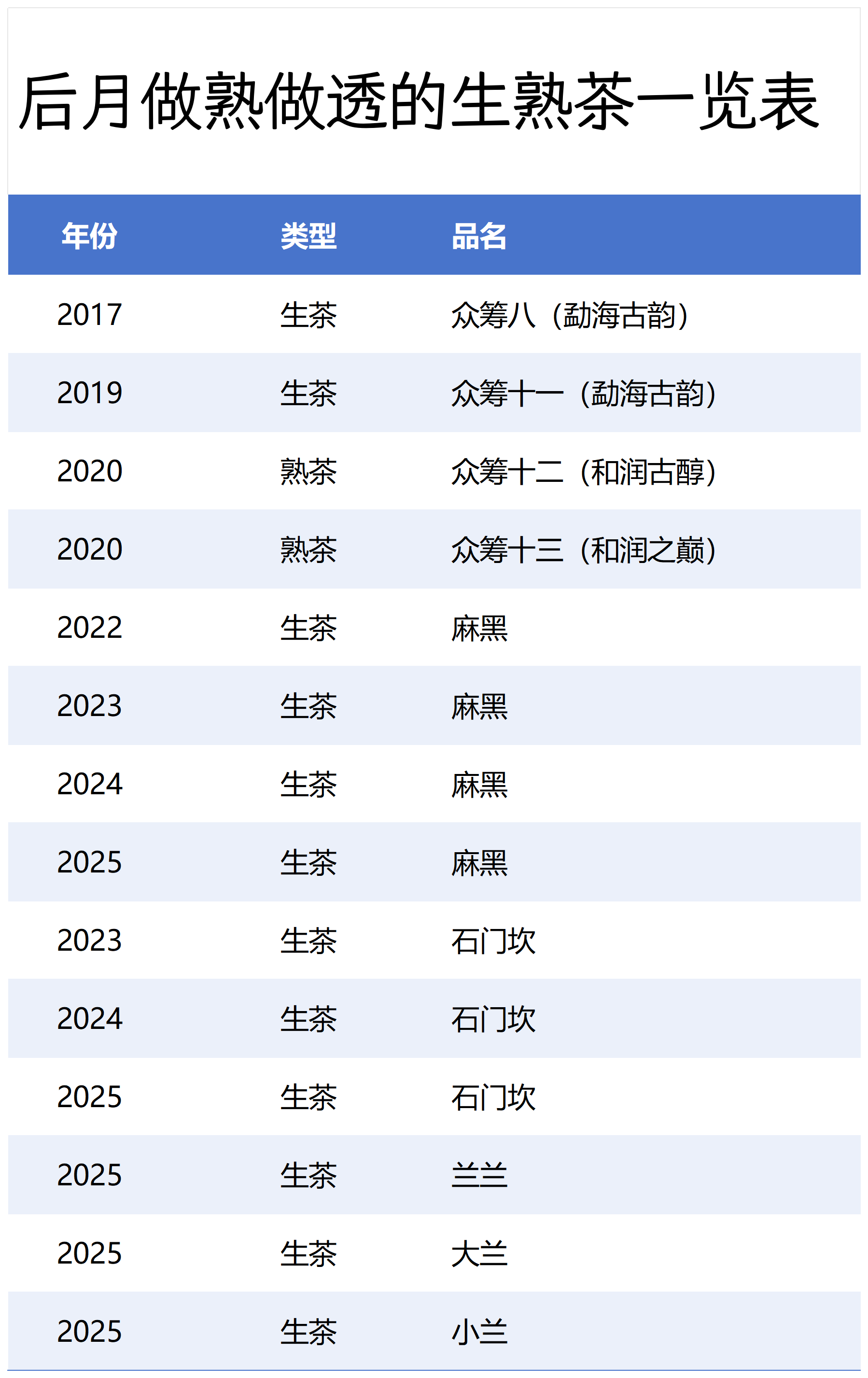
A list of Houyue's fully fermented and fully processed tea products!
People often ask me which teas are fully fermented and fully processed. I have made a table. Welcome to try the teas according to the table.
This is the thirty-seventh article in my "Paper Talk on Tea" series. Click to view more "Paper Talk on Tea" articles.
Paragraph comments 0 · moderated
Comments 0 · moderated