
Good ripened tea is not necessarily ancient tree ripened tea, but if ancient tree ripened tea is not good ripened tea, I personally think there is no need to make it at all. Today, I will be narrow-minded and only talk about ancient tree ripened tea.
It can be said that from the first day I came into contact with tea, I mainly focused on ripened tea. Later, through crowdfunding, I concentrated on making up for the lessons on raw tea, but ripened tea still received the most attention. In the previous "Tea Talk on Paper," I mentioned that the sales volume of ripened tea on our 51 Pu-erh website is far greater than that of raw tea, which is also an important reason why I have paid attention to ripened tea for a long time.
After doing crowdfunding, due to increased understanding of high-end raw tea, I discovered a new world of ripened tea. The previous simple four indicators of ripened tea—fragrance, sweetness, thickness, and smoothness—I think are far from enough. Taking advantage of this plan to continue the "Tea Talk on Paper" series on ripened tea, I will sort out the ten indicators that I think constitute good ripened tea. This is only my opinion; you may listen as you will. Still, as I said, if you think I am talking nonsense or even farting, that is your opinion. In short, you must have your own judgment and your own cognitive system. There is no right or wrong, only whether it is suitable, in order to make good tea. Following others blindly only leads to worse results.
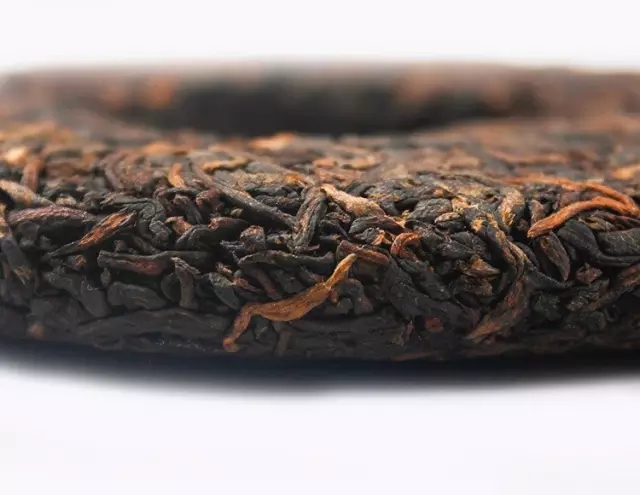
Ten Indicators of Ancient Tree Ripened Tea.
1, Fragrance
I don't understand recognizing a woman by her scent, but recognizing tea by its scent is the first priority. There are three kinds of tea fragrance: the fragrance wafting in the air when brewing is the lowest; the fragrance on the container and the leaves after steeping is medium; the fragrance contained in the tea soup is the highest. Good tea generally has all three fragrances. Fragrance also has strong and light distinctions. Vulgar perfumes can be smelled from three rooms away, but they are pungent and uncomfortable. The fragrance of good tea must be light, elegant, and elusive. This kind of comfortable fragrance is the noblest.
2, Sweetness
Sweetness is the same. No one likes the sweetness of saccharin. The sweetness of good tea is also light and cool. At the moment you feel a bit of sweetness, and after leaving the tea, half a day on the road you can still have an endless aftertaste—that is the sweetness good tea should have.
3, Smoothness
Smoothness is the easiest to understand and also easy to achieve. Teas with a slightly longer age mostly have smoothness. The highest level of smoothness, in my opinion, is when the tea hardly needs to be swallowed; it goes down the throat and into the stomach by itself. The drinker will be surprised, thinking, "I haven't swallowed yet." Smoothness also has a certain relationship with thickness.
4, Thickness
I like to drink hot rice porridge. The mouthfeel and throat resonance are very good, full and flavorful; cold rice porridge feels insufficient in taste, watery. This is the most vivid metaphor I can find for the thickness of tea. Some say concentration is thickness, some say intense flavor is thickness. I think both have some truth, but neither is comprehensive. Thickness is concentration or intensity wrapped in pectin. Tea with pectin and thickness generally has smoothness. Only concentration or intensity is not right. I personally think such tea is harmful to the body.
5, Mellow
Mellow refers to the purity of taste and the flavor of age after aging.
Purity of taste: without obvious pile flavor or water flavor, just a pure ripened tea taste, also without the刺激性 of new tea, soft, mellow, and palatable.
Flavor of age: the taste of tea becomes more and more平和, the intensity disappears, leaving mellowness and gentleness. The power of softness is another interpretation of mellow.
6, Fineness
For raw tea, we often talk about the fineness of the soup. For ripened tea, fineness is rarely mentioned because good ripened tea is indeed rare. Good ripened tea should also have a fine and moist soup, comfortable on entry, and the more you drink, the more you like it.
7, Softness
Regarding the softness of tea soup, I have communicated with many peers and tea friends. Most recognize softness as a feeling of fineness and smoothness, but I do not quite agree. There is a phrase, "pearl-like and jade-like," meaning round and smooth. A round and smooth tea soup has no burrs, no edges. The tea soup passing through the throat causes no discomfort, and the body seems to need no effort to adapt. The mouthfeel is very comfortable, the body even more so, and drinking more will not harm the body in the slightest. I do not know how to describe this feeling more; I think you need to drink more and compare more. For example, the third crowdfunding tea, sun-dried black tea, has a very soft soup. The fourth crowdfunding ripened tea also has a very soft soup. Drink them in comparison, quietly experience alone, and it is easier to understand.
The opposite of softness is hardness. Tea that is both fine and hard is the most harmful to the body. When you drink hard tea, your body needs to use its strength to absorb it. After a few cups, you may feel a bit tired, and your stomach may also feel uncomfortable. Many old tea friends think this is intolerance to tea and dare not drink, or else they will have stomach pain or insomnia at night. In fact, it is mainly the hardness of the tea that makes the body uncomfortable. If you have this feeling, you can try soft tea and compare more. Fineness makes people feel that the tea is high-end and can't help but drink more, and the body cannot bear it. This is also why I launched a slogan when crowdfunding sun-dried black tea: "Do not be entangled in taste; make healthy tea." In fact, this is the case. Many partners who participated in the sun-dried black tea crowdfunding have such a feeling: after often drinking our crowdfunding sun-dried black tea, they find that the tea they previously thought was very delicious is a bit hard to swallow. I think the best manifestation of tea speaking is this.
Teacher Liang often talks about the word "裂解" (cracking). At first, I was puzzled, but later after drinking a large number of teas and comparing, suddenly one day I understood. The knowledge of tea is really vast. I have learned a lot from Teacher Liang and Teacher Huang, and I feel very fortunate. I think the word "裂解" is a very key word. It is true for Pu-erh tea, and also for other teas. The main characteristic of "裂解" tea is that the soup feels fine, soft, warm, and moist, so that the body is not tired by the tea and can feel the beauty of the tea.
8, Purity
Purity refers to a feeling of the body. This tea is very pure; tea is tea, without pesticide residues, without defects in processing or storage. To ensure high purity, the entire process must be controlled from the beginning: select good raw materials, be careful in rough processing, spread and wither off the ground,适度杀青 (proper fixation), timely and proper rolling, and pollution-free sun-drying. For this part, you can refer to my article: "Tea Talk on Paper" I: Making Tea and Making Tea. After making the rough tea, it needs to rest for a period before fermentation. There are even more points to note in fermentation; I will write a separate article another day. If the tea is made very well, but there are storage problems, it is not good. If the fresh leaves have problems, such as using pesticides and chemical fertilizers, purity cannot be achieved. If the process is not meticulous, it takes a long time to gradually become pure.
9, Smoothness (of the body)
Smoothness is also a feeling of the body. Smooth tea will not cause discomfort when drunk. It is the same as softness; softness mainly refers to the feeling in the mouth and stomach, while smoothness is the feeling of the whole body. The opposite of smoothness is obstruction. Teacher Huang calls obstruction "滞" (stagnation). Smoothness indicates a cycle; a continuous cycle is smoothness, and the body will be very comfortable. Obstructed tea may cause abdominal bloating, headache, or even weakness and fatigue—various discomforts.
10, Charm (Yun)
Charm is a sense of imagery in the tea. The most heard is "drinking the taste of the sun," which is a kind of charm. Tea has charm; charm makes the body愉悦, and the body may present a picture. I personally think that the sense of imagery is the highest state of tea drinking comfort. Some people may have unpleasant imagery with bad tea.
These are the ten indicators of good ancient tree ripened tea as I understand them.
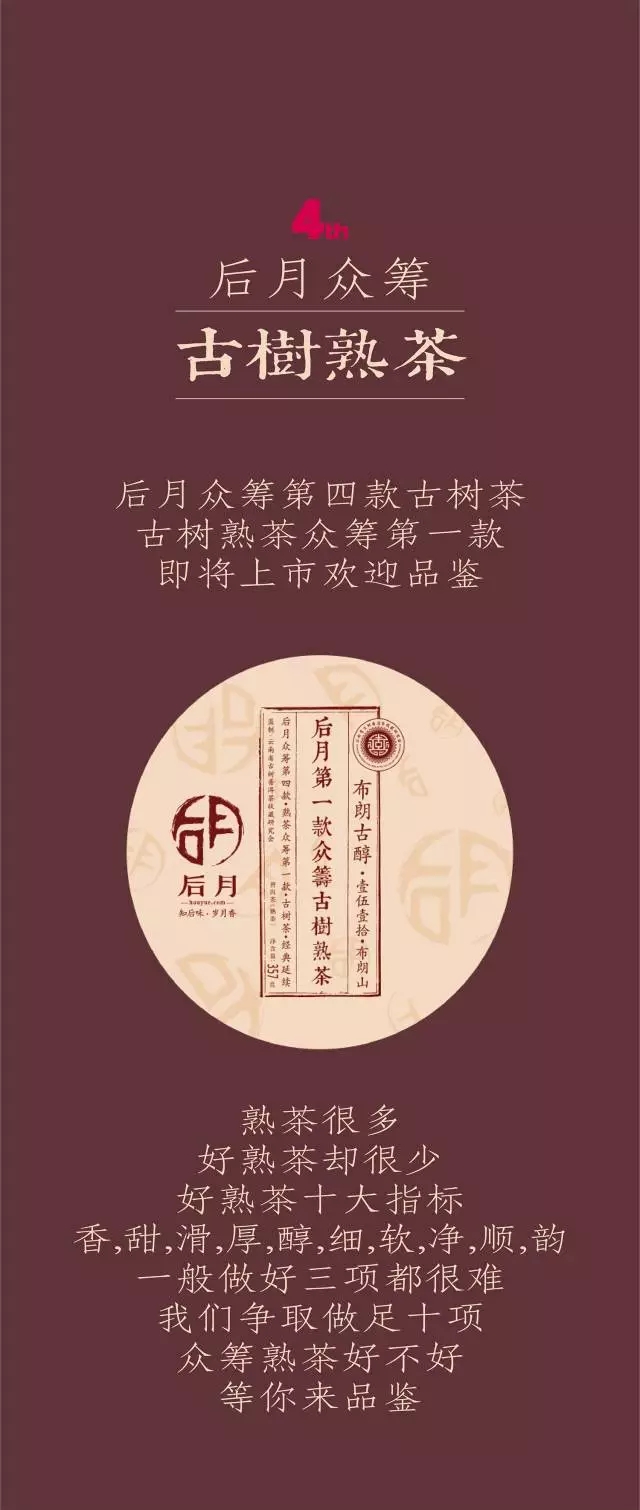
If you agree but cannot find a good ripened tea sample to compare, I recommend you try our first crowdfunding ripened tea, which is the Houyue Bulang Ancient Mellow shown below. You may discover more.
If you cannot feel many of these, I have some life suggestions. If you can persist, perhaps when you come to drink tea again, you will be able to feel them. First, make your life lighter: less salt and oil in dishes. This also has the benefit of being able to taste the original flavor of ingredients. Think about why Cantonese cuisine is often considered tasteless by many but is relatively expensive. Second, eat more vegetarian food to make the body peaceful. Finally, cultivate yourself, such as meditation and quiet contemplation. I am just a beginner in this part, so I will not say much.
In tea tasting, we often hear the word "糯" (glutinous). But what exactly is glutinous? Different people have different explanations. Many experts cannot explain clearly, and I have not seen an explanation of glutinous in published tea books. Most of the time, we communicate orally when drinking tea. Glutinous is a kind of soup feel. Glutinous tea is not necessarily thick, and thick tea is not necessarily glutinous. I think glutinous is a combination of fineness, smoothness, and thickness. I will not list it as a separate indicator.
The above is my personal understanding. I am Lü Jianfeng from 51 Pu-erh. My opinion is one-sided. I still say: I speak as I may, and you listen as you may. I wish everyone a happy life through tea tasting.
This article is original. Reproduction must not delete this statement. The article and images are original. Author: Lü Jianfeng, WeChat: 673998, working at 51 Pu-erh, initiator of Houyue crowdfunding tea.
Comentarios por párrafo 0 · moderado
Comentarios 0 · moderado