
People often discuss with me the issue of Oriental Leaf and whole leaf tea, worrying that whole leaf tea has no future, saying that Oriental Leaf has no additives and is also a pure tea beverage made from raw tea, with a decent taste, etc...
Today I'll write a short article to share my views.
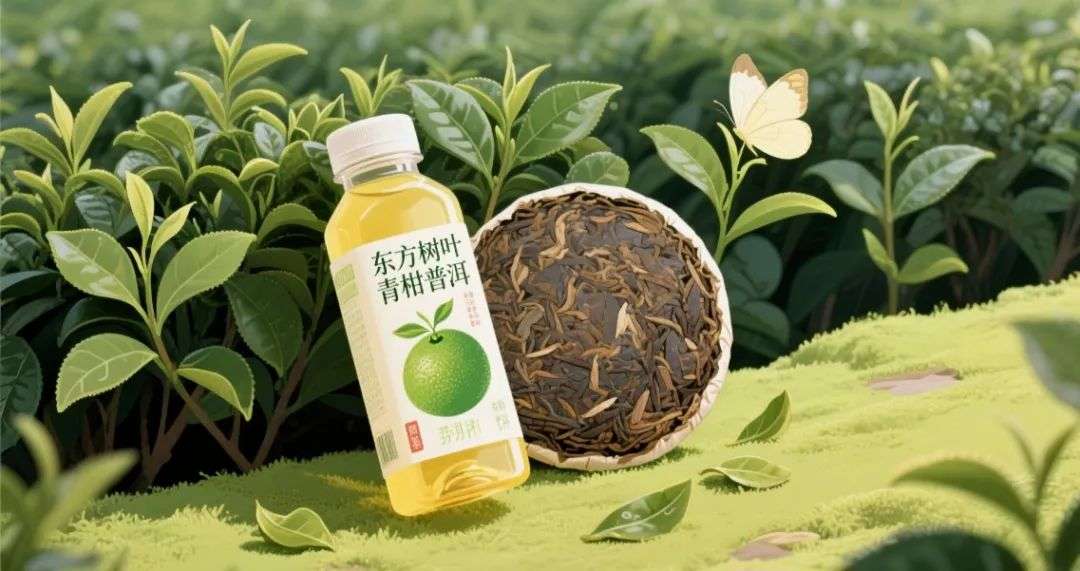
- Comparison of consumption between Oriental Leaf and traditional whole leaf tea.
I found that the Oriental Leaf Black Oolong flavor directly indicates the amount of tea added (>3g/L). Let's calculate how much tea leaves are needed to brew one liter using a traditional gaiwan.
All my data uses industry standards; those who like to argue, please stay away.
Assume a 130ml gaiwan with 6 grams of tea leaves. To produce one liter, you'd need about ten infusions, plus one for rinsing, that's eleven infusions of water. By then, 6 grams of tea would have lost its flavor. So the traditional tea consumption should be (6g/L).
Conclusion: Traditional whole leaf tea consumption is double that of Oriental Leaf.
- Let's calculate the tea cost.
I don't know the cost of Oriental Leaf's oolong tea procurement, but I do know the cost of their Pu'er tea procurement, which is approximately within 30 yuan/KG. Taking Oriental Leaf's Tangerine Peel Pu'er drink as an example, let's assume the Pu'er consumption per liter is also 3g (though I estimate it should be less than 3g, actually 1-2g. We won't consider the tangerine peel consumption because if tangerine peel is used, the Pu'er consumption would be less). 30/1000*3=0.09 yuan, the tea cost per liter is 9 cents (the direct tea cost per 500ml bottle is 4.5 cents).
What is the cost of traditional Pu'er tea?
In 2024, the average price of dry raw tea in Yunnan province was 48.4 yuan/kg, according to official data. Let's use this to calculate the cost.
The cost of 6 grams is 48.4/1000*6=0.29 yuan.
Cost comparison: 0.29/0.09=3.22 times.
The cost of brewing whole leaf tea is 3.22 times that of Oriental Leaf.
- Oriental Leaf's processing consumption
Oriental Leaf tea has a shelf life of mostly 9 months.
I've done tests: Pu'er ancient tree ripe tea soup, after 15 days, has a lot of flocculent material and is undrinkable.
To achieve a 9-month shelf life, Oriental Leaf uses UHT sterilization, which likely kills some of the normal tea flavors. Pure milk also uses UHT sterilization for long-term preservation. Comparing fresh milk and pure milk, we know that the fresh, moist feeling of fresh milk cannot be matched by pure milk.
- Conclusion.
- Whole leaf tea has higher costs. Moreover, many low-end teas are consumed by deep processing (like Oriental Leaf tea drinks). The actual cost of brewing whole leaf tea should be more than 3 times the average cost. Higher-cost whole leaf tea is a more premium choice.
- Whole leaf tea is similar to fresh milk, with a better fresh and moist taste.
- Whole leaf tea is more worth savoring. Most enthusiasts choose higher-grade tea materials, such as Yiwu forest ancient tree tea, which costs thousands per kilogram. These teas can bring out the charm of the forest. Oriental Leaf mainly uses plantation tea, so how can it have such charm?
- Oriental Leaf and whole leaf tea are like fast food and private kitchen cuisine. Fast food is everywhere, but it doesn't affect private kitchens. Each has its own demand; it's not either/or, but mutual coexistence and development.
This is the thirty-eighth article in my "Paper Talk Tea" series. Click to view more "Paper Talk Tea" articles.
Comentarios por párrafo 0 · moderado
Comentarios 0 · moderado