
I came to tea from the internet industry, so I'm very sensitive to keywords. If we discuss the hot keywords of Pu'er tea, we can easily list a bunch: ancient tree tea, aged tea, ripe tea, raw tea, Tea Horse Road, Lao Ban Zhang, Bingdao, Dayi, Xiaguan, cake tea, pure material, state-owned forest, health, tea culture, Zen and tea as one... and many more. But if we have to say which keyword ranks first, I think it must be 'more fragrant with age'.

Regarding the 'more fragrant with age' of Pu'er tea, it originated in 1995 when Taiwanese scholar Mr. Deng Shihai published the first formal monograph on Pu'er tea, "Pu'er Tea", in which he first proposed the saying 'more fragrant with age'. According to some research, it was the first time Pu'er tea used the phrase 'more fragrant with age'. My Taiwanese teacher Liang Xiangtian has repeatedly mentioned the origin of 'more fragrant with age'. At that time, Mr. Deng originally wanted to say that Pu'er tea tastes better with storage, but that was obscure and too long for dissemination. 'The older, the better' was not quite appropriate either, so 'more fragrant with age' was formally proposed.
There is also information indicating that the theory of 'more fragrant with age' was proposed by Wang Shuwen (currently the president of Kunming Tea Promotion Association):
Wang Shuwen is the first person in Yunnan to systematically propose the concept and theory of tea. As early as 1989, he published an article in the magazine "Yunnan Tea" systematically proposing the narrow and broad concepts of tea, which are still recognized by the tea academic community today.
Wang Shuwen is also the first person in Yunnan to propose the viewpoint that Pu'er tea is 'more fragrant with age', completely negating the traditional concept that 'wine should be aged, tea should be fresh'. As early as 1984, he published the theory that 'Pu'er tea is resistant to storage and has the characteristic of becoming more fragrant with age' in "Yunnan Tourism Products and Arts and Crafts Collection". Subsequently, many media reported his theory of 'more fragrant with age' for Pu'er tea. (Source: Yunnan Legal Network, "An Ascetic Promoting Yunnan Ethnic Culture: A Record of Wang Shuwen, an Old Tea Man Who Started Midway")
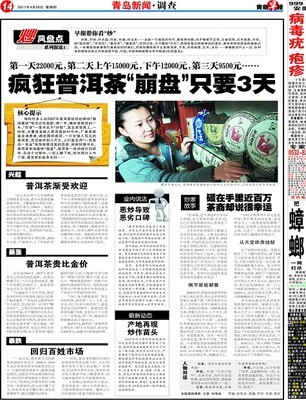
Since then, Pu'er tea has benefited from these four characters and achieved considerable development, reaching its peak in 2007. I only started 51 Pu'er website in December 2008, and later many peers described the grand occasion to me. Because Pu'er tea becomes more fragrant with age, a lot of hot money entered for speculation. At the craziest time in 2007, a batch of tea bought for 200,000 yuan today could be sold for 250,000 yuan the next day; as long as the packaging had the three characters 'Pu'er tea', it would be swept away; as soon as goods arrived in the store, someone would immediately bring out a pile of money to collect them, even the sample tea on the shelves was wanted. Many stores had no tea at all; everything was sold out.
On April 20, 2007, in Guangzhou, Dayi 7542 dropped from a high of 23,000 yuan per piece to 17,000-18,000 yuan per piece in one day. On May 20, it plummeted from 16,000 yuan per piece to 11,000 yuan per piece. This is the famous Pu'er tea crash. On November 15, 2007, Tian Xiaomai published an article in "China Securities Journal" titled "Pu'er Tea Prices Experienced Soaring and Plunging: Market Value Evaporated 15 Billion Yuan in Vain". What does 15 billion mean? In 2015, Yunnan's dry raw tea production was 362,000 tons with a total output value of only 11.1 billion yuan, of which Pu'er tea was only 125,000 tons. Even if Pu'er tea's unit price is high and accounts for about half of the output value, roughly converted, it evaporated nearly three times the annual output value of Pu'er tea in 2015. Another example: a certain brand's iron cake in 2007 had a wholesale collection price of 4,500 yuan per piece. In 2010, I collected a large amount at less than 400 yuan per piece and sold them on 51 Pu'er at a price of over ten yuan with free shipping. Even today, nine years later, the price of this tea per piece is still around 1,500 yuan. The media's title of 'crazy Pu'er tea' is not an exaggeration.
'More fragrant with age' brings confusion.
After natural transformation over time, the taste of Pu'er tea indeed becomes richer, and the initial bitterness and astringency of new tea disappear naturally over time. It can be said that this is the most charming aspect of Pu'er tea, and it is also the biggest selling point that tea factories and merchants introduce to tea friends. 'More aged' is a time concept, and 'more fragrant' is a quality concept. 'More fragrant with age' means exchanging time for quality: the longer the time, the better the quality, and the better the quality, the more popular it is, and the more people chase it, the more expensive it becomes.
Smart merchants have long prepared various auxiliary statements, such as 'store old tea, drink new tea'. Selling cake by cake is tiring, so they directly tell you that Pu'er tea needs storage, and if you buy a whole piece or many pieces at a discount, it will taste better when stored. They imply or even explicitly say it will appreciate in value. So merchants store tea and sell it when it's old, and consumers also store tea to drink old tea at a low price in the future. Various funds enter the Pu'er tea industry to hoard tea. On one side, there are reports of big shots hoarding 7,000 tons of tea, and on the other side, people say that's not much at all; someone has hoarded tens of thousands of tons or more.
I have specifically investigated many tea hoarders from around 2005. Their current situation is that they don't know who to sell to. Their previous downstream channels also have a lot of inventory, resulting in prices lower than new tea but still not selling. The most terrifying thing is that they don't know how low the price must be to sell. From a market perspective, it may not be 'more fragrant with age' for them. I have obtained many samples. Compared with new tea, I personally think their taste may not have an advantage, and some are even far inferior to new tea. From a taste perspective, these teas may not necessarily be 'more fragrant with age'.
When Deng Shihai was interviewed by "Pu'er" magazine in 2008, he gave a new interpretation of 'more fragrant with age'. He said: The concept of 'more fragrant with age' is not my invention; I just brought it out. From a scientific perspective, tea certainly cannot become more fragrant with age, but from an artistic perspective, it does exist. Science and art are two cultural systems. We cannot view art only from a scientific point of view. It is important to coordinate the relationship between the two. It doesn't taste good at first, then gradually tastes good; this is 'more fragrant with age'. But everything has a limit. When is the limit for Pu'er tea? Those who do art don't need to consider these things; they don't need to study or define it. They just need to return to their own artistic level.
Why is it not necessarily 'more fragrant with age' in terms of taste and market?
Today is an era of rapid development. It is difficult to succeed with only one trick. The new generation, which is individualistic, doesn't care whether it's old tea or new tea; what matters is that they buy it happily and drink it comfortably. The Pu'er tea industry has developed from the single model of 'more fragrant with age' to a diversified model including ancient tree tea, 'more fragrant with age', mountain tea, state-owned forest, high-stem tea, private customization, etc. With the diversity of the marketing market, it is natural that sticking only to 'more fragrant with age' leads to increasing loneliness.
In the past, people drank old tea because new tea was hard to drink, but these are changing. Previously, there were few primary processing facilities on tea mountains; now standardized primary processing facilities are everywhere. In the past, Lao Ban Zhang used woks for cooking to fry tea (see my article "Tea Talk on Paper No. 6: Reflections on Standard Samples of 2016 Spring Ancient Tree Tea"). Now, almost every household in Lao Ban Zhang has a primary processing facility, and tea frying uses large woks with dedicated fire delivery. Previously, women fried tea; now only experienced masters are qualified to fry tea. Previously, defects in primary processing, such as the hardness, astringency, sharpness, bitterness, blandness, and green, musty, and miscellaneous tastes of new tea, can now be solved through reasonable processing techniques. The process concept of my current crowdfunding teas is: drinkable now, and also amazing after long storage. The unique fresh fragrance of new tea is not present in old tea, and the mellow taste of old tea is not liked by everyone, nor is it a necessary condition. With improved processing, the taste of new tea has greatly improved, providing a foundation for large-scale drinking. The trend that old tea becomes more niche is inevitable from a taste perspective.
Previously, the crude primary processing led to many teas not tasting good even after storage. Garbage tea, no matter how long it is stored, is still garbage tea. This is also a major reason. Some merchants' storage orientation led to a large amount of old tea being stored in wet warehouses, and many other improperly stored old teas are mixed with normally stored old teas, causing the overall quality of old tea to be worrying. Storage is another major reason. The new generation is willing to try new things and is willing to be constantly touched by new concepts, which is also an external factor. It is very reasonable and a fact that some new teas are more expensive than old teas. 'More fragrant with age' was the biggest driving force for Pu'er tea before, but it also caused an inversion between tea storage and actual consumption. More and more people are storing tea, and the quantity is increasing. Some estimate that even if no tea is produced for ten years, the existing stock cannot be consumed. It is time to face this issue. When a large number of old tea hoarders see no hope and rush to sell, that will be the crash of old tea. Of course, some old teas with good quality and scarce quantity are not in this category.
It may be more fragrant with age, or new tea may be good too. There is no right or wrong; it's just your choice—this is the consumer's choice, and of course, it is also the market's choice: it is best to respect this choice!
The article is original, and the images are from the internet.
The author is Lu Jianfeng, CEO of 51 Pu'er website, and initiator of Houyue crowdfunding tea.
Paragraph comments 0 · moderated
Comments 0 · moderated